
Four Shifts Reshaping the Hefei Hostel Market
People keep asking us the same question: Jushe started in April 2025 and opened four locations in prime Hefei districts inside a year — how did it move that fast?
The answer is less dramatic than they want. We are not fast. The whole category is changing lanes. The underlying logic of the hostel business has been rewritten over the last three to five years — the guests changed, the supply changed, the way money is made changed, even the logic of acquiring buildings changed. Jushe just happened to be standing in the right place when it happened.
No sentimentality in this piece. Just the four shifts we have watched happen.
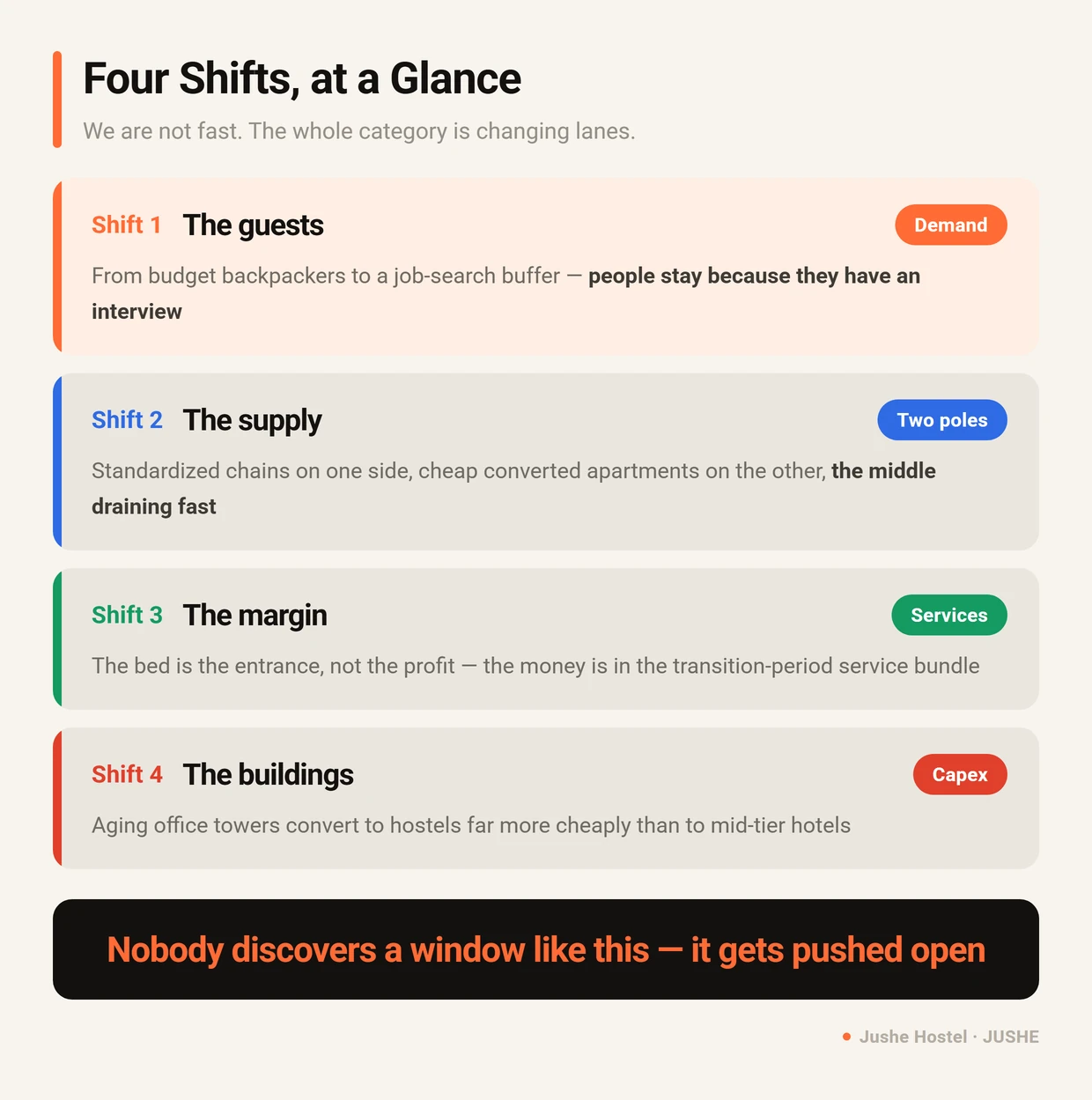
Shift one: the guests, from budget backpackers to a job-search buffer
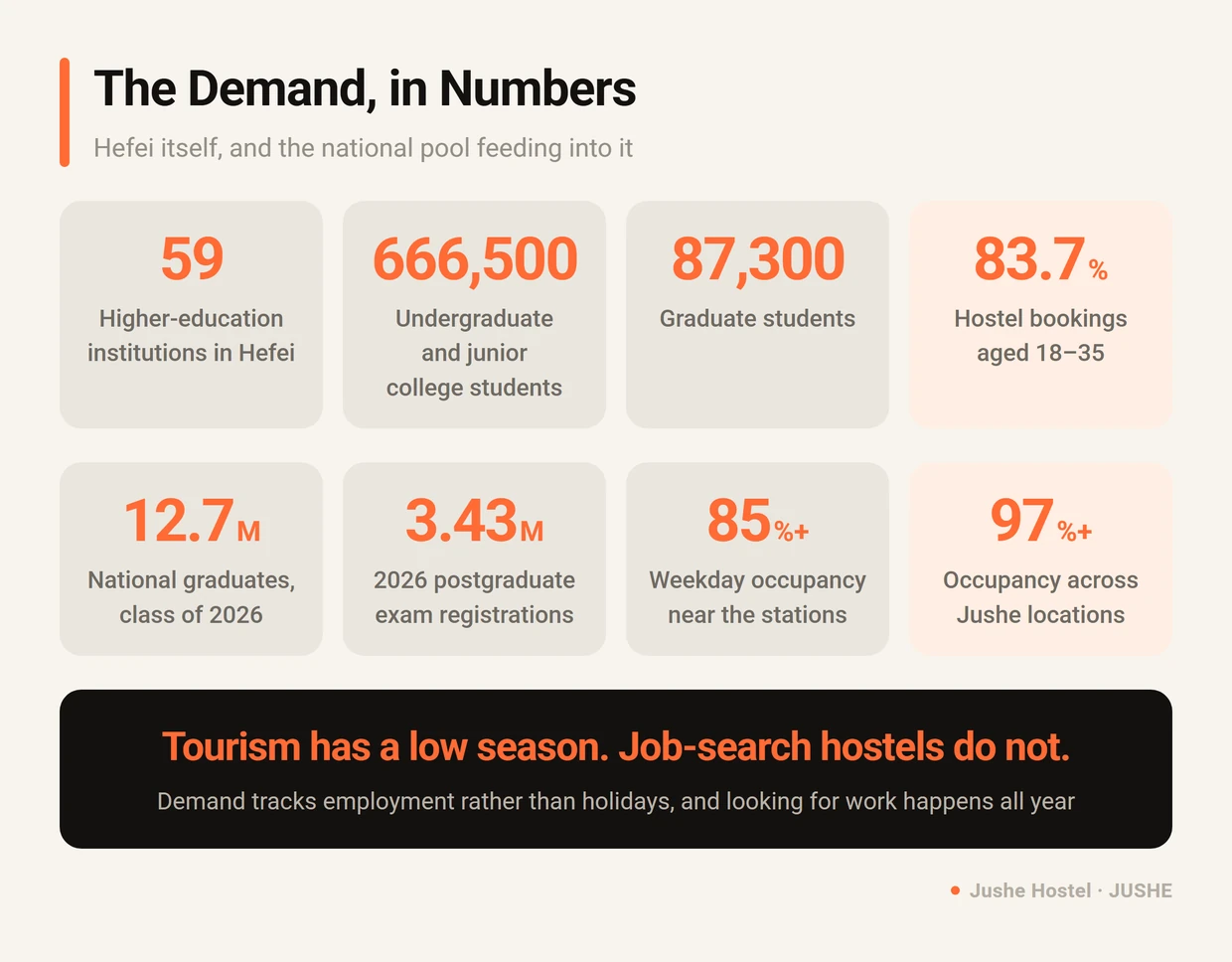
In national hostel booking data, 18-to-35-year-olds make up 83.7%, and people born after 2000 alone are 51.2%. That holds in Hefei too, but the local driver behind it is much sharper.
Start with Hefei's own numbers. The city has 59 higher-education institutions, with 666,500 undergraduate and junior college students and 87,300 graduate students. A city of ten million contains 750,000 young people who are about to graduate, intern, or interview at any given moment.
But what really opens the market up is the flow into Hefei from the rest of the province. Hefei is Anhui's capital, and the new-energy vehicle, integrated circuit, and photovoltaic clusters have almost all landed here, so job density is far higher than anywhere else in the province. Which means graduates from Wuhu, Fuyang, Anqing, Lu'an, Suzhou — nearly every prefecture-level city — try Hefei first. They are not local, they have nowhere to stay, and the first thing they have to do after getting off the train is find somewhere they can put down for ten days or two weeks.
Zoom out and the pool is larger still: the Ministry of Education projects 12.7 million college graduates nationally for the class of 2026, 480,000 more than the year before; 3.43 million people registered for the 2026 postgraduate entrance exam; flexible employment nationwide has passed 200 million people, with 84 million in new forms of work. Graduating, grad school, civil service exams, gig work — those four roads cross at the same group of 18-to-28-year-olds.
And they share one behavior pattern: changing jobs means changing cities. Their radius of movement is not home-to-office, it is city-to-city. So a hostel became the default for the first night in town.
Ten years ago people stayed in hostels because they were traveling. Now they stay because they have an interview.
Hefei's new-energy vehicle, IC, and photovoltaic clusters keep posting openings, and out-of-town candidates keep arriving. The hostel rulebook — from 19 RMB a night, around 450 RMB a month, no deposit, free cancellation before 6 p.m. on the first night — is almost purpose-built for the rhythm of "interview at three places, then decide."
What deserves more attention is the depth of the pool: these flows stack, they do not substitute for each other. New graduates come during spring and fall recruiting. Exam candidates come between the written test and the interview. Gig workers land here between cities. Interns stay a whole semester. Hostels around Hefei Railway Station and Hefei South Station hold weekday occupancy above 85% year-round.
There is a counterintuitive wrinkle in the current job market too: the winter and summer breaks, which ought to be the slow season, have become peak. The harder jobs are to find, the longer the search runs. A wave moves in straight from graduation in June and July, summer interns fill in behind them, exam candidates spend the entire break in the study room, and the people coming back after the New Year arrive ahead of spring recruiting.
So the curve splits completely from tourist lodging: tourism has a clear high and low season; job-search hostels have no low season. Demand does not track holidays, it tracks employment — and looking for work happens all year. That is the underlying reason Jushe's four locations have held occupancy above 97%.
We wrote up the full arrival process for out-of-town job seekers separately in the 2026 Hefei job search guide.
Shift two: supply splitting in two, around a pair of station hives
The supply side has changed harder than the demand side, and it has changed in two directions at once — some players exiting, others sprinting.
The old properties are leaving. Traditional travel-oriented hostels have shrunk in Hefei as everywhere else, and passion projects are closing at a startling rate. The ones still standing mostly survived by converting to long-stay. A business model that serves only travelers can no longer feed itself in this city.
The new ones are sprinting. Hefei Station (Lines 1 and 3) and Hefei South Station (in the catchment of Wanghucheng West on Line 1) have grown two extremely dense hostel hives. Around the south station, near Damo Wall Street Plaza and Wanghucheng West, more than five hostel brands compete inside a 331-meter radius. Beside the main railway station, our own location and several others are a five-minute walk apart, and slicing one building into multiple floors of separate rentals is now normal.
There is an extreme case that circulates online about a 30-story building packed with 32 hostels. In the converted older office towers around Hefei Station you can already see something close to it: one building carved up by different sub-landlords into several coexisting hostel brands.
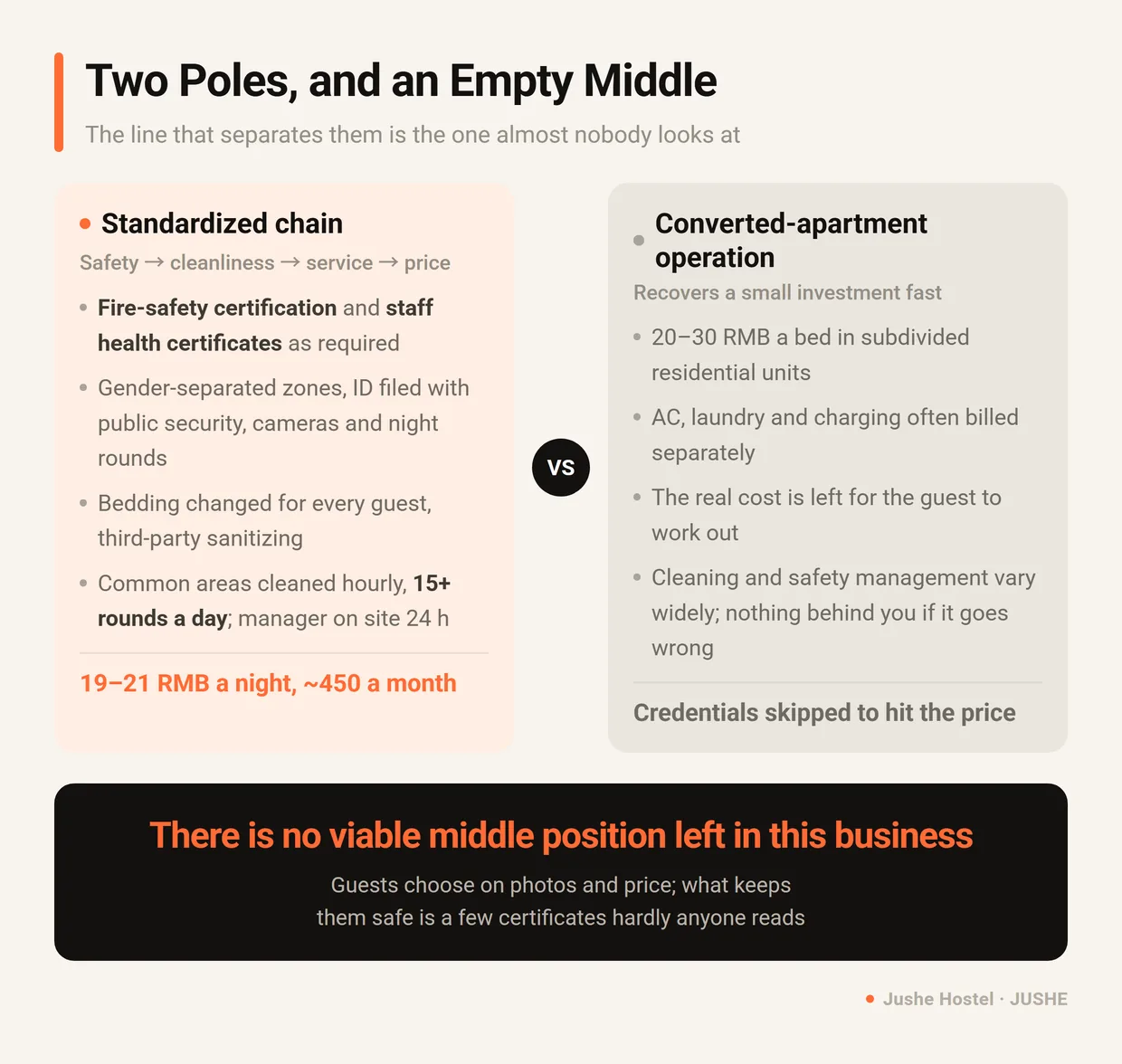
Inside that hive, supply is cracking into two clear poles.
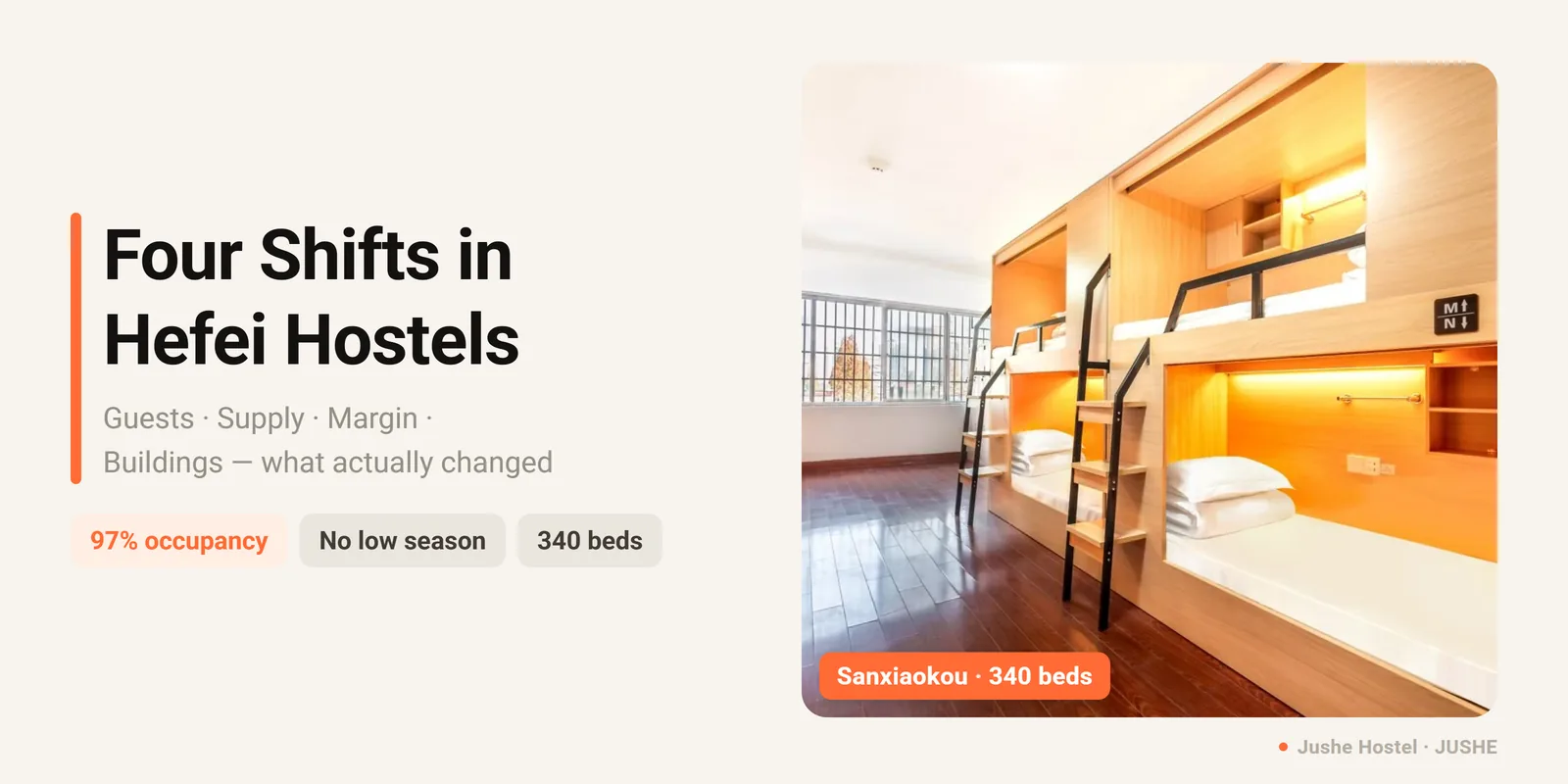
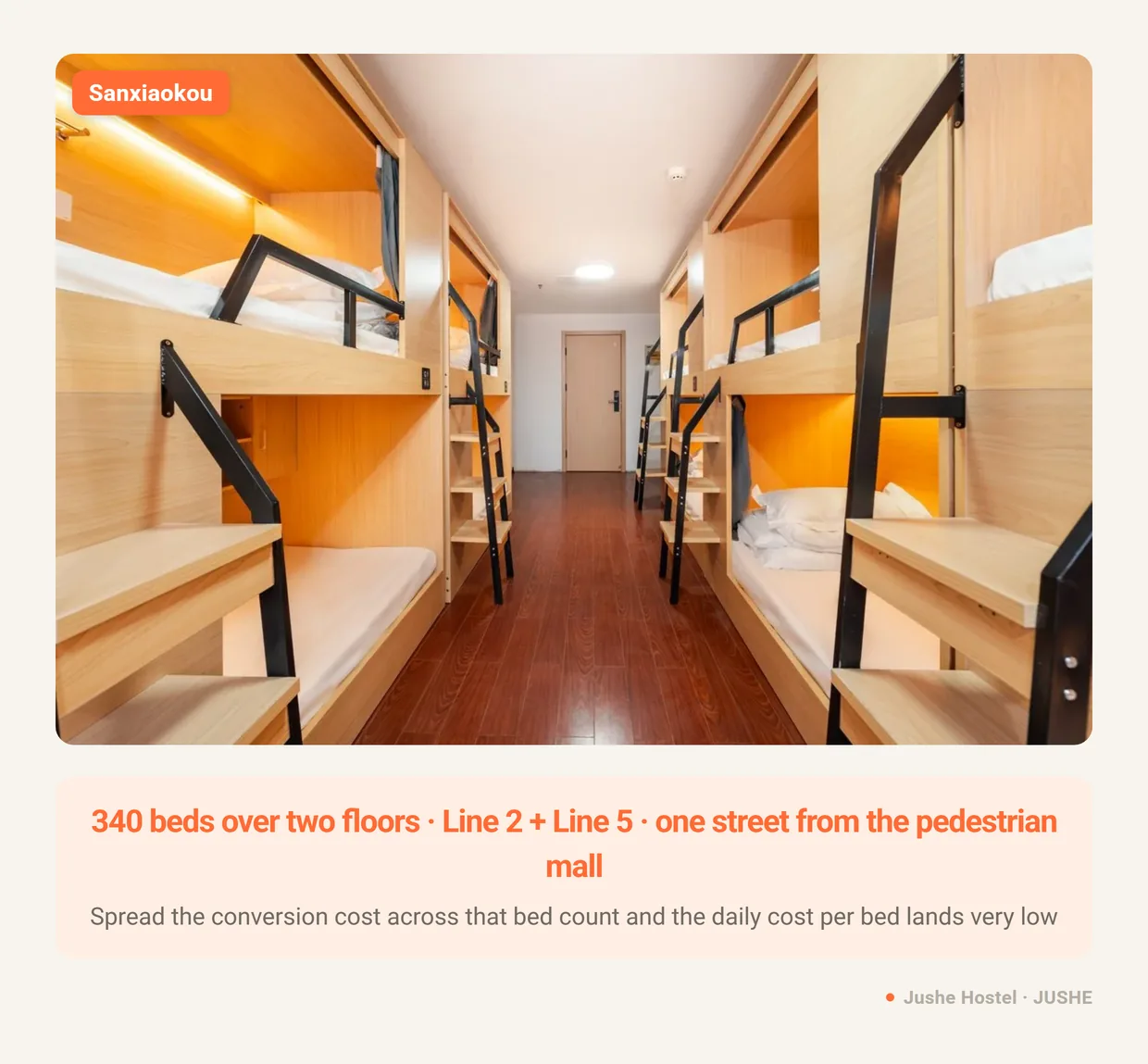
One pole is the standardized chain. Jushe Hostel currently runs four locations in prime Hefei districts — Hefei Railway Station, HFUT South Campus, West Qilitang, and Sanxiaokou. Sanxiaokou occupies floors 6 and 7 of the Futong Times Building, 340 beds across the two floors, the largest single property in Anhui. What holds that chain standard up is a deliberately ordered floor: safety first, then cleanliness, then service and convenience — every location holds fire-safety certification as required, and staff work with valid health certificates, with men's and women's zones, ID registration filed with public security, cameras throughout, and overnight rounds; bedding changed for every guest and sanitized at high temperature by a third party; common areas and bathrooms inspected and cleaned every hour, more than 15 rounds a day; a manager on site 24 hours. Only after all of that come the conveniences — 19–21 RMB a night, around 450 a month, self check-in.
The other pole is the cheap converted-apartment operation. Around the south station there are a great many hostels carved out of residential units at 20–30 RMB a bed, where air conditioning, laundry, and charging are often billed separately and the real cost is left for the guest to work out. These recover their small investment fast, but cleaning standards and safety management vary widely, and if something goes wrong there is essentially nothing behind you.
There is one line that separates the two poles better than anything else and that almost nobody looks at: credentials. Fire-safety certification and staff health certificates are not marketing copy. They are documented thresholds that cost money, force renovations, and require periodic re-inspection. Most individually run subdivided hostels do not have them and do not intend to; for a chain brand they are the first gate you have to clear before you can open at all. Guests choose a hostel on photos and price, but what actually determines whether they are safe is a few certificates on the wall that hardly anyone reads.
Between the two poles, the middle is draining fast. There is no longer a viable "neither good nor bad" position in this business.
Shift three: beds are the funnel, and the margin lives in the services around them
People assume hostels make money on the spread between what a bed costs and what it rents for. It is the reverse: gross margin on a bare bed is very thin. The bed is the entrance, not the profit.
Start with the quality baseline. Hefei's newer hostels left the grimy stereotype behind a while ago. In the 19-RMB-and-up tier, Jushe first holds the hard safety and cleaning lines — gender-separated zones, ID verification, bedding changed for every guest, hourly cleaning rounds in the common areas — then makes standard equipment of capsule-style partitioned bunks, blackout curtains, individual reading lights, wet-and-dry-separated bathrooms, a free study room, and QR-code washers and dryers. The hardware spec is aimed at budget hotels, but because bunks and shared space are used in combination, the renovation cost amortized per bed is actually lower. That is the sharpest hit hostels have landed on budget hotels.
The real economics live in the transition-period service bundle. Over the 14 to 30 days a job seeker spends in the city, they need considerably more than a mattress:
· resume printing, interview grooming, hourly rooms for a nap, a local job board;
· conversion to weekly and monthly rates (around 450 RMB a month, which brings the nightly cost down to about 15 RMB, and conveniently locks in one full job-search cycle);
· study-room time passes, laundry punch cards, and revenue share from local social events.
Generator in London is the international reference for this model — beds account for only 48% of its revenue, with the rest coming from food, beverage, and events. The Hefei version is structured somewhat differently: beds around 60%, value-added services around 40%. But the marginal cost of the value-added half is very low, so it is nearly pure incremental margin.
The cost side is just as lopsided. A budget hotel has to carry a lobby, corridors, and a front desk on three shifts. A hostel runs on self-service entry plus a WeChat manager, compressing the night shift to one person doubling up. Revenue per square meter is maximized by using bunks and common areas in combination, which is a structural advantage with price-sensitive job seekers. How that math compares to renting is laid out in long-term rental vs. short stay.
Shift four: existing buildings, and the cash-flow answer for aging stock
The last shift happens somewhere guests never see: acquiring the building.
Hefei's permanent population passed ten million in 2025, and its new-energy vehicle output ranks among the highest in the country. "A city that raises people" is not a slogan — industrial workers, R&D interns, and rotating sales roles together generate steady, low-frequency, long-tail demand for housing. That demand is scattered, short, and starts and stops at will, which a hostel absorbs far more easily than a long-stay apartment operator.
The conversion path is now well understood. Aging office towers, old hotels, and mixed-use buildings within 1.5 km of the two stations cost far less in capex to turn into a hostel than into a mid- or upper-tier hotel. Our Sanxiaokou location leases two full floors, 6 and 7, for 340 beds; spread the total conversion cost across that bed count and then across the operating period, and the daily cost per bed lands very low. The payback period is clearly shorter than a mid-tier chain hotel in the same area.
The cash-flow advantage is more direct still. Put that 97% into the model. At Sanxiaokou, 340 beds mixing short stays and monthly rates at an average of about 20 RMB per bed per night puts monthly revenue near 200,000 RMB (340 × 20 × 97% × 30 ≈ 198,000), roughly 2.4 million a year. And none of it is discounted for a low season.
More important than the revenue is the shape of the risk. Hostel income settles daily and is divided 340 ways: an empty bed costs 20 RMB that day. A long-stay apartment on a deposit-plus-three-months lease loses a full month the moment a unit empties, and the next tenant is ten days or two weeks away. A hostel cuts risk into 340 pieces; a long-stay apartment bets it on one whole unit. Chain it across four locations, layer the value-added services on top, and that resilience goes up another notch.
For local owners sitting on older buildings, this points to a steadier option: leasing a whole floor to a brand like ours under full management is more stable than renting piecemeal to short-let operators, and more controllable than gambling on an upmarket conversion.
The risk boundary: what a surviving hostel looks like
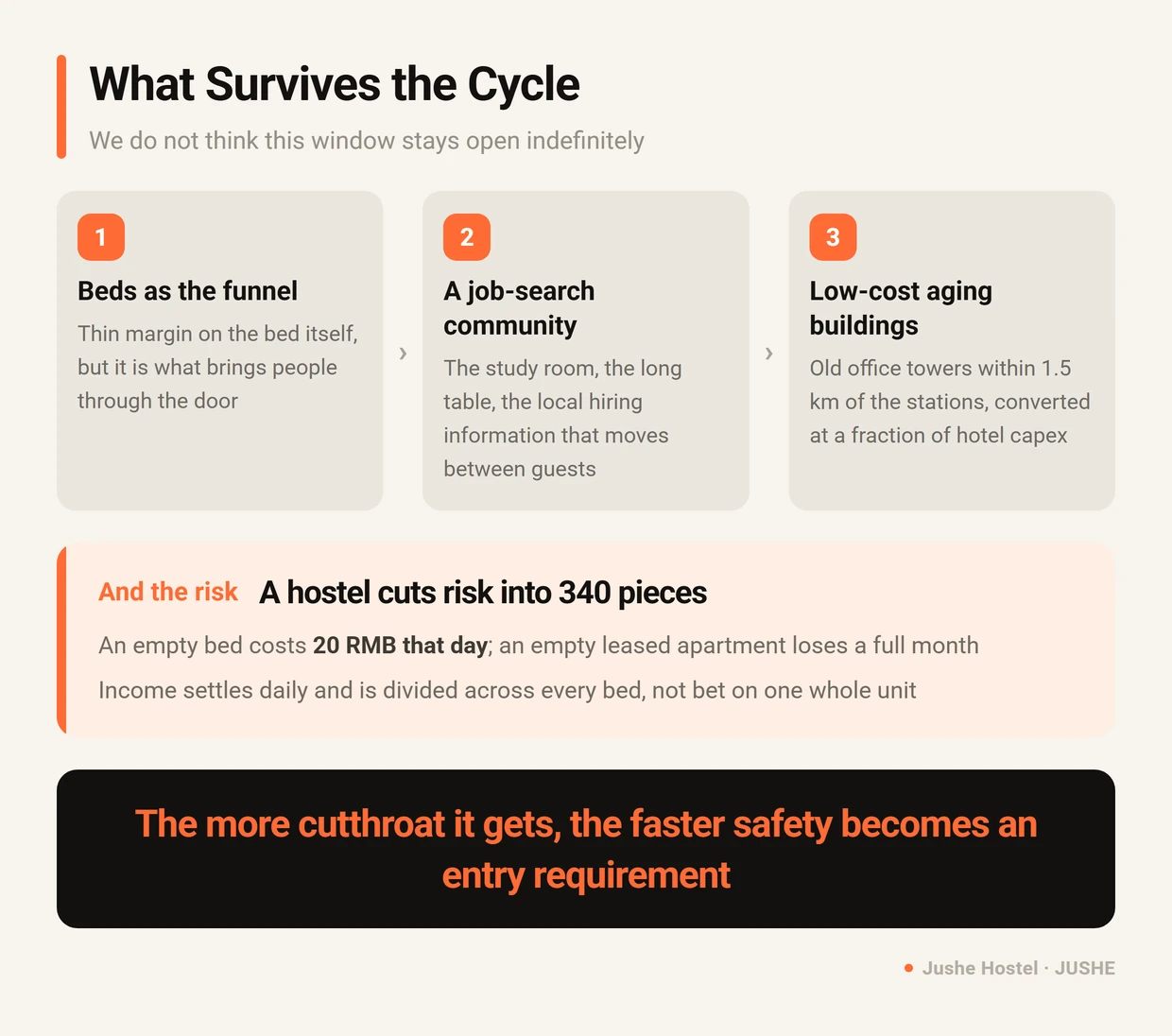
We do not think this window stays open indefinitely. Price-cutting is the biggest variable in this business right now.
Workshop-style hostels with no brand, no ID registration, and no cleaning standard will be cleared out as chains expand — not because competition beats them, but because compliance and reputation eventually do. The more cutthroat the category gets, the faster safety and cleanliness turn from bonus points back into entry requirements: anyone can be cheap, but only operators who hold gender separation, ID verification, and per-guest bedding year in and year out deserve to stay at the table.
The ones that survive the cycle will be holding three things at once:
beds as the funnel, a job-search community, and low-cost aging real estate — all three, none optional.
Cheap without quality gets cleared out. Quality without cost control never reaches scale. And an operator with the building and the money but no read on a job seeker's hours and anxieties ends up with a cheap room, not a place where someone can breathe.
What Jushe has spent the past year doing is making all three solid at the same time:
· Hefei Railway Station — five minutes on foot into the station, instant check-in on a midnight arrival
· HFUT South Campus — Line 1 direct to both stations, home base for exam prep and campus recruiting
· West Qilitang — Line 2 and Line 3, the Sanlian commercial hub next door
· Sanxiaokou — the largest single property in Anhui, 340 beds over two floors, dead center of the city
Nobody discovers a window like this. It gets pushed open by the period you are living in. All you can do is finish the work before it arrives. More of what we stand for is on the About Jushe page.
If you are job hunting in Hefei right now: from 19 RMB a night, no deposit, a one-night minimum, utilities included, 24-hour self check-in, and free cancellation before 6 p.m. on your first night. Get settled first, then take your time picking the job that is worth it.