
Renting vs. a Short Stay: Which Actually Costs Less?
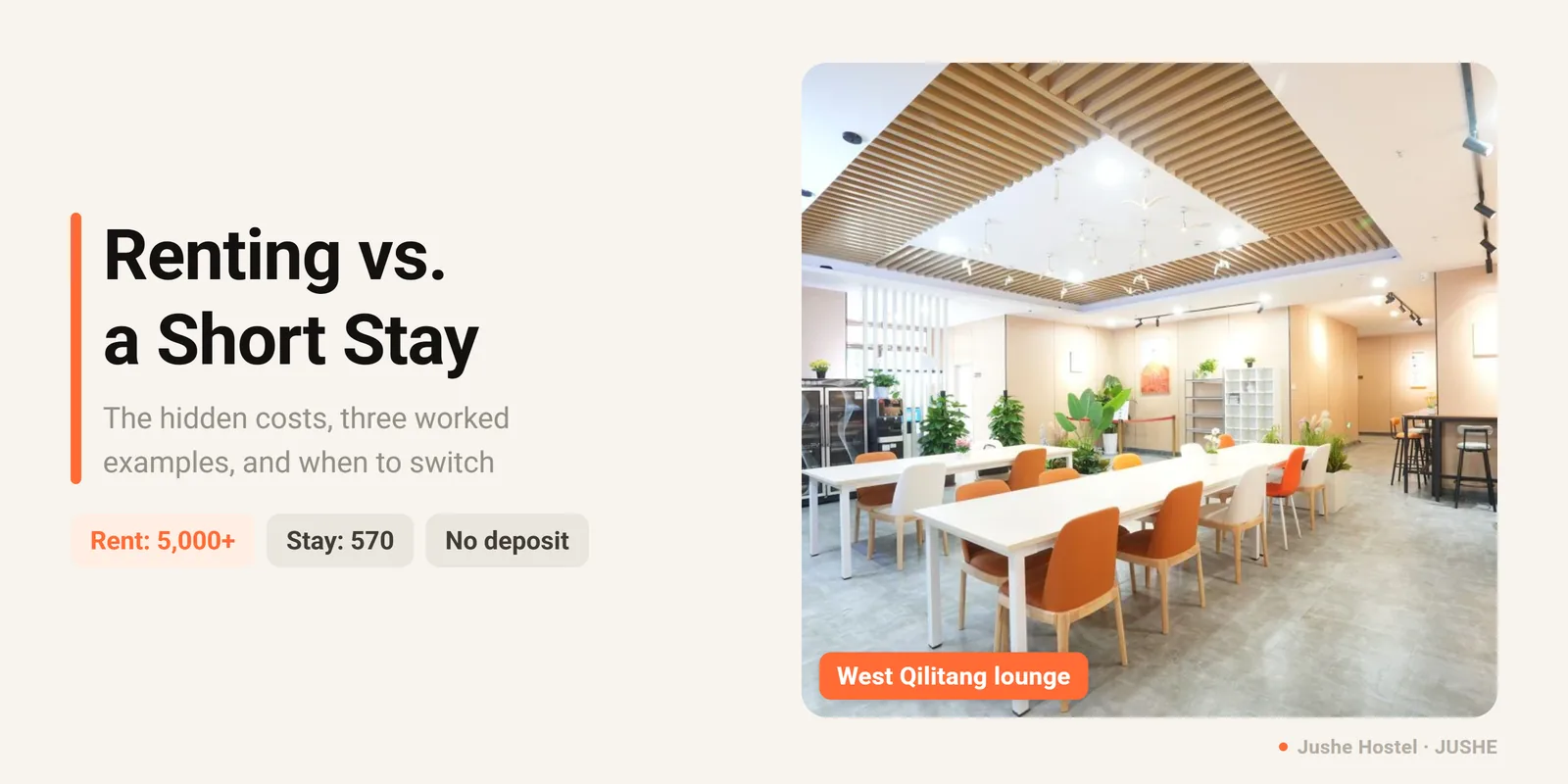
A lot of people arriving in a new city think the first move is to rent a place and get settled. But if your job is not locked in, if the search might drag, or if you are only here for a three-month internship or project, signing a lease is usually the most expensive option available to you at that moment.
This is not an argument against renting. It is the arithmetic, laid out line by line, so you can decide for yourself.
What renting actually costs, beyond the rent
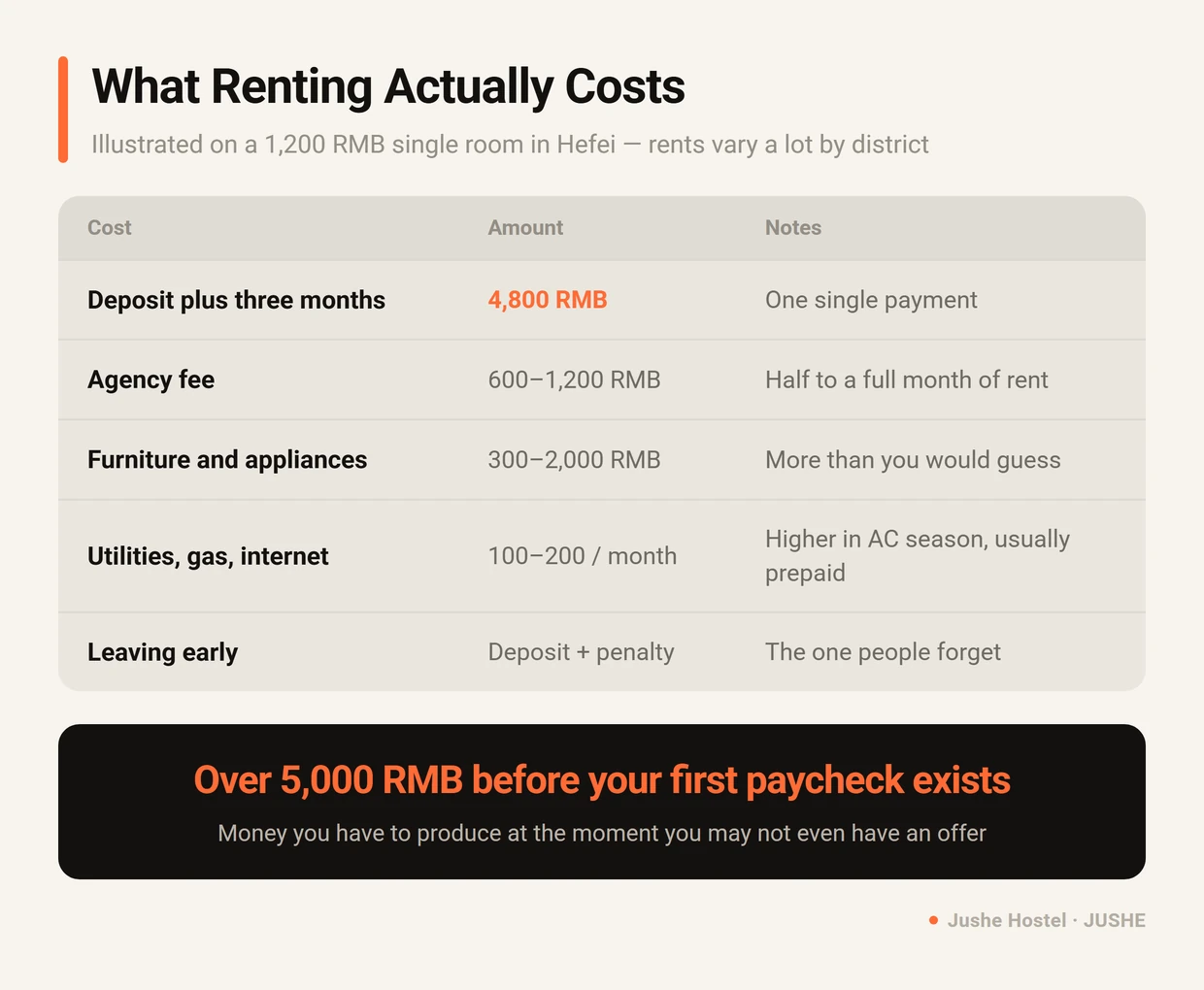
The number quoted during a viewing is monthly rent. What determines how much cash you need is this list.
One: the deposit-plus-three-months up front. Take a 1,200 RMB single room in Hefei as an illustration — actual rents vary a lot by district. One month's deposit plus three months' rent is 4,800 RMB in a single payment.
Two: the agency fee. Convention is half a month to a full month of rent, so 600–1,200 RMB.
Three: furniture, appliances, and everyday stuff. An empty unit needs more than you would guess — bedding, cookware, a drying rack, a trash can, and the pile of small things that end up on a bathroom shelf. Anywhere from a few hundred to a couple thousand RMB.
Four: utilities, gas, and internet. Roughly one to two hundred RMB a month, higher in the air-conditioning months, and usually prepaid.
Five: the cost of breaking the lease. The one people forget, and the one that hurts. Leave before the term is up and the deposit is generally gone, sometimes with an additional penalty on top.
Add just the first two and getting into a rental in Hefei generally takes more than 5,000 RMB — money you have to produce before your first paycheck exists.
What a short stay costs: settled daily, nothing sunk
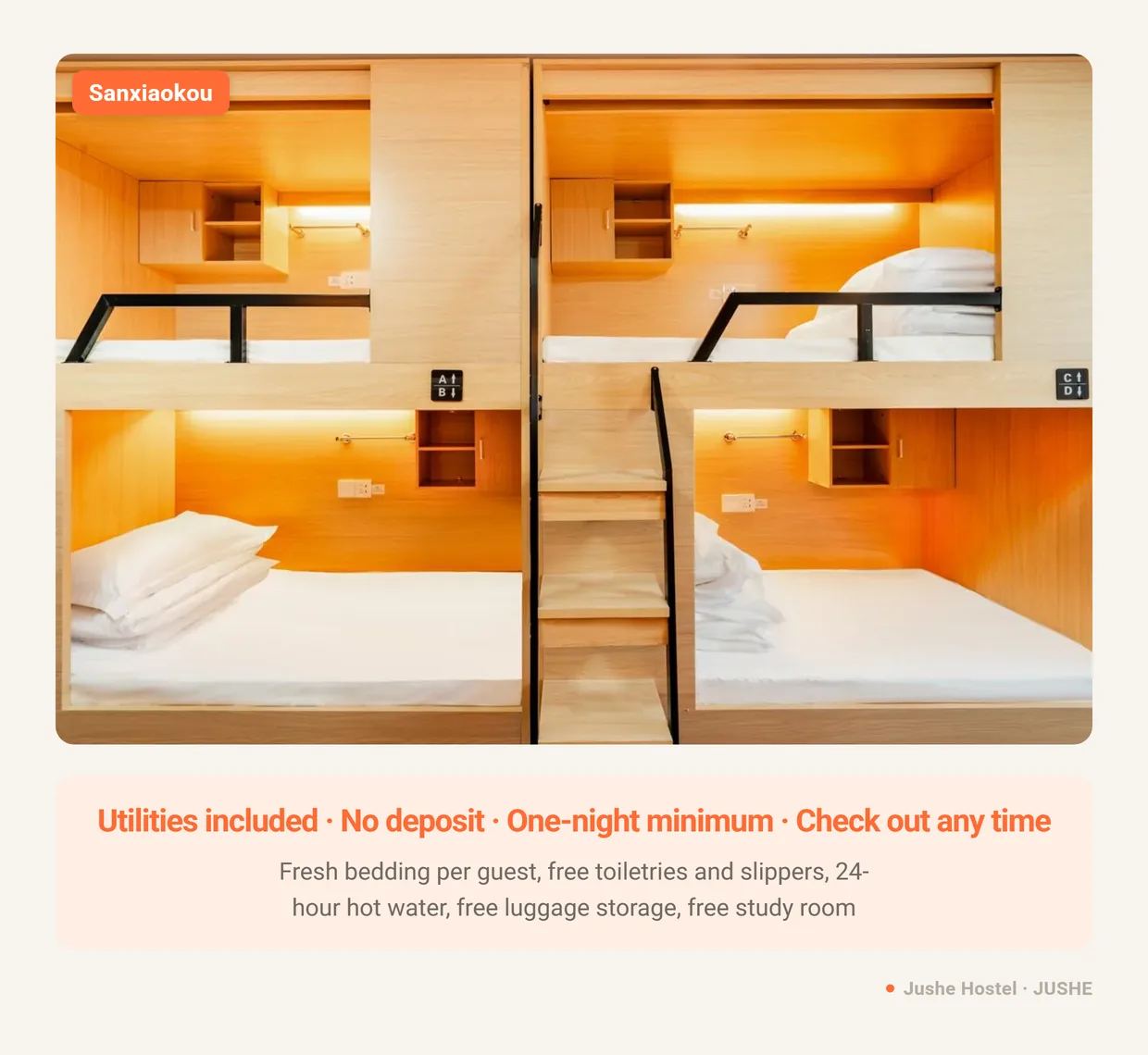
The math on a standardized youth hotel is much simpler. Across Jushe Hostel's room types: 10-bed rooms 19–21 RMB a night, 8-bed 23–24, 6-bed 26–27, 4-bed 29–30, utilities included, no deposit, one-night minimum, check out whenever.
Beyond the room rate you do not need to buy anything. Bedding is changed for every guest. Disposable toiletry kits, shampoo and body wash, and slippers are free. There is 24-hour hot water and filtered drinking water, individual air conditioning, free luggage storage, and a free study room. Washers and dryers are 2–3 RMB a load by QR code.
The part that matters most: you can leave at any time, and your cost is the nights you already slept. No deposit withheld, no penalty, and no apartment full of things you now have to unload.
Three situations, worked out
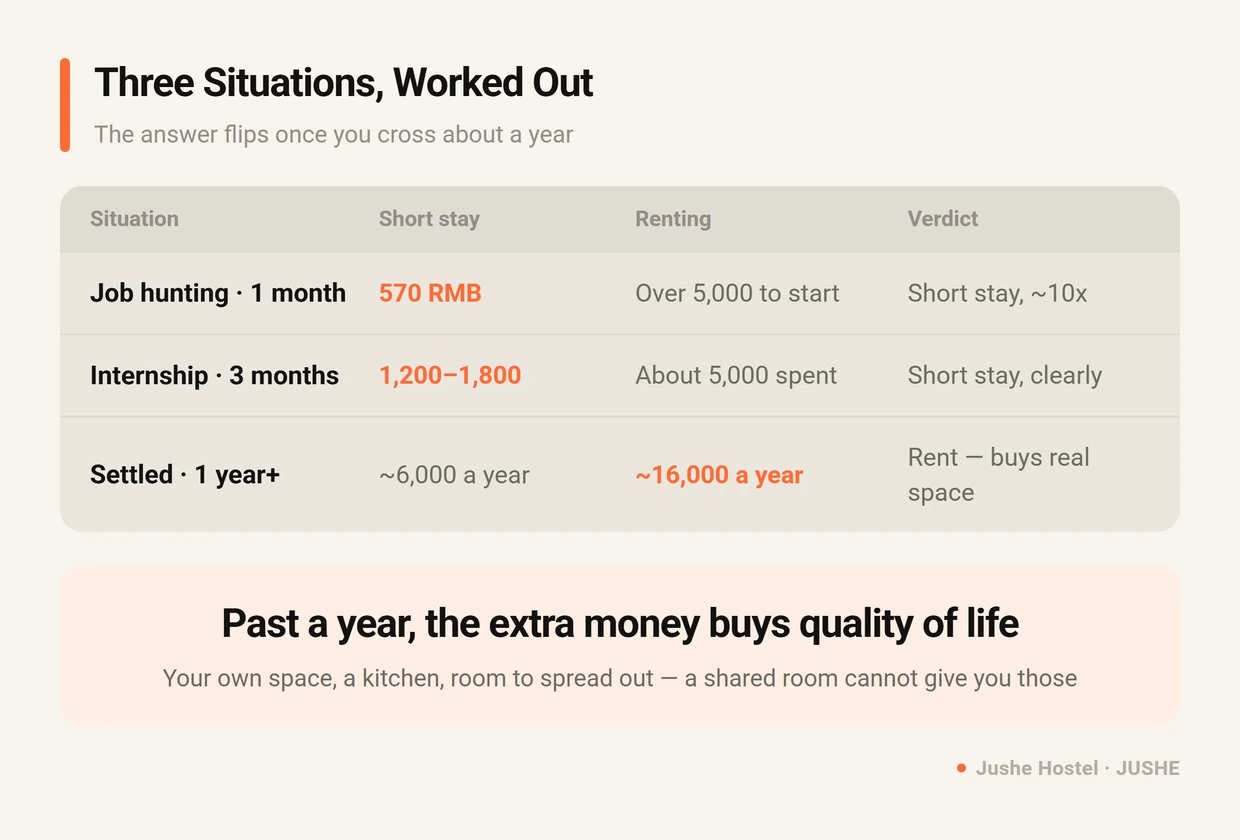
Situation one: job hunting from out of town, roughly a month.
Short stay: a 10-bed room at 19 RMB a night for 30 nights is about 570 RMB. At HFUT South Campus, which has a monthly rate, the same room is 400 RMB.
Renting: more than 5,000 RMB to start, and if the offer that lands a month later is across town, you eat the cost of breaking the lease.
Verdict: the short stay wins by nearly ten to one.
Situation two: an internship or short project, three months.
Short stay: at 400–600 RMB a month, three months runs about 1,200–1,800 RMB.
Renting: 4,800 RMB up front, plus a 600 RMB agency fee, plus roughly 800 RMB for appliances and odds and ends, so about 6,200 RMB. The 1,200 RMB deposit comes back after three months, so call it 5,000 RMB actually spent, plus about 500 RMB of utilities and internet.
Verdict: the short stay is still clearly cheaper, and it saves you the time of moving in and out.
Situation three: the job is settled and you plan to stay a year or more.
Short stay: at a 500 RMB monthly rate, a year is about 6,000 RMB, but you are accepting shared-room schedules and shared bathrooms for twelve months.
Renting: 1,200 RMB a month over 12 months is 14,400 RMB, about 16,000 with startup costs — and what you get is your own space, a kitchen, and room to actually spread your life out.
Verdict: here the extra money is buying quality of life, which is a fair trade. Rent the apartment.
When to switch from short stay to a lease
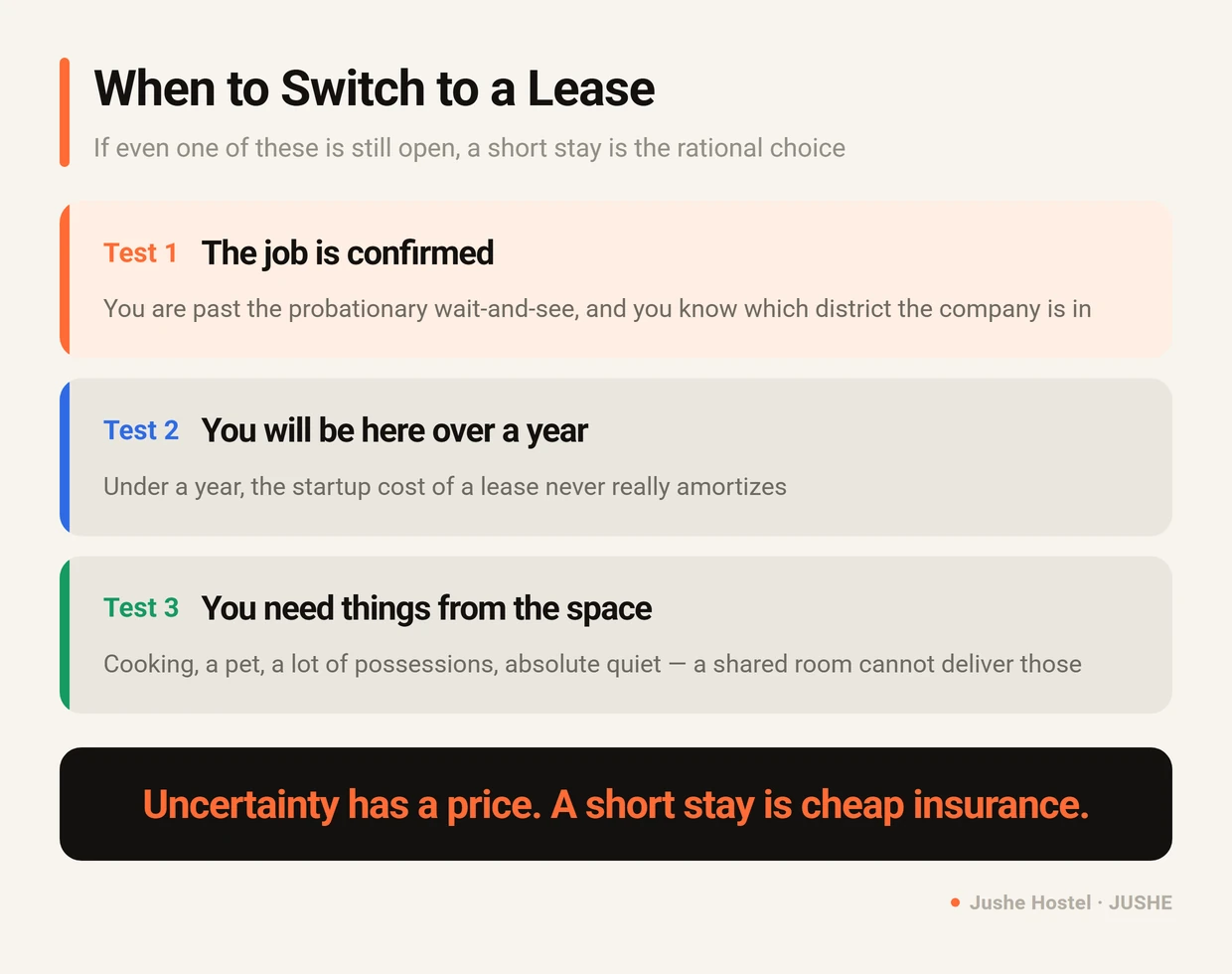
There are really only three tests. When all three are true, go sign.
One: the job is confirmed and you are past the probationary wait-and-see. You know what district the company is in and whether you intend to stay.
Two: you plan to be in this city more than a year. Under a year, the startup cost of a lease never really amortizes.
Three: you have specific needs from your living space. Cooking, a pet, a lot of possessions, absolute quiet — a shared room cannot give you those.
If even one of those is still open, a short stay is the more rational choice. Uncertainty has a price, and a short stay is a cheap insurance policy against it.
A few comparisons people skip
Commuting. Cheap rent is usually far from the metro. Forty extra minutes a day is 20 hours a month, and during a job search you are also paying the round trip to every interview. All five Jushe locations are within walking distance of a station, and that is precisely what you are buying.
Safety. In a shared apartment, your roommates are whoever the landlord found. At Jushe, ID registration is filed with public security, there are cameras throughout, overnight security rounds, and men's and women's zones — it is a more controllable situation, not a less controllable one.
Moving. Changing where you live during a job search is more likely than not. Changing hostels means checking out and booking again. Changing apartments means a lost weekend and a moving fee.
The psychological cost. Not quantifiable, but very real: having 5,000 RMB in your account and having 5,000 RMB sitting with a landlord produce completely different levels of nerve when you walk into an interview.
The conclusion
There is nothing wrong with a lease. It is a question of timing. Locking money into a long contract before your income and your footing are settled is paying a premium for uncertainty. Once the job is steady and the direction is clear, every yuan of that lease is going somewhere it should.
Until then, what Jushe Hostel wants to do is hold the cost of the in-between period down as far as it will go: from 19 RMB a night, no deposit, a one-night minimum, utilities included, check out any time. For how to arrange housing around a job search, see the Hefei job search guide; pricing and cancellation rules are in the FAQ.
Run the numbers first, then decide how you want to live. See daily, weekly and monthly rates by location →