
Traveling Alone: Safety, Cleanliness, Service, and the Paperwork Nobody Checks
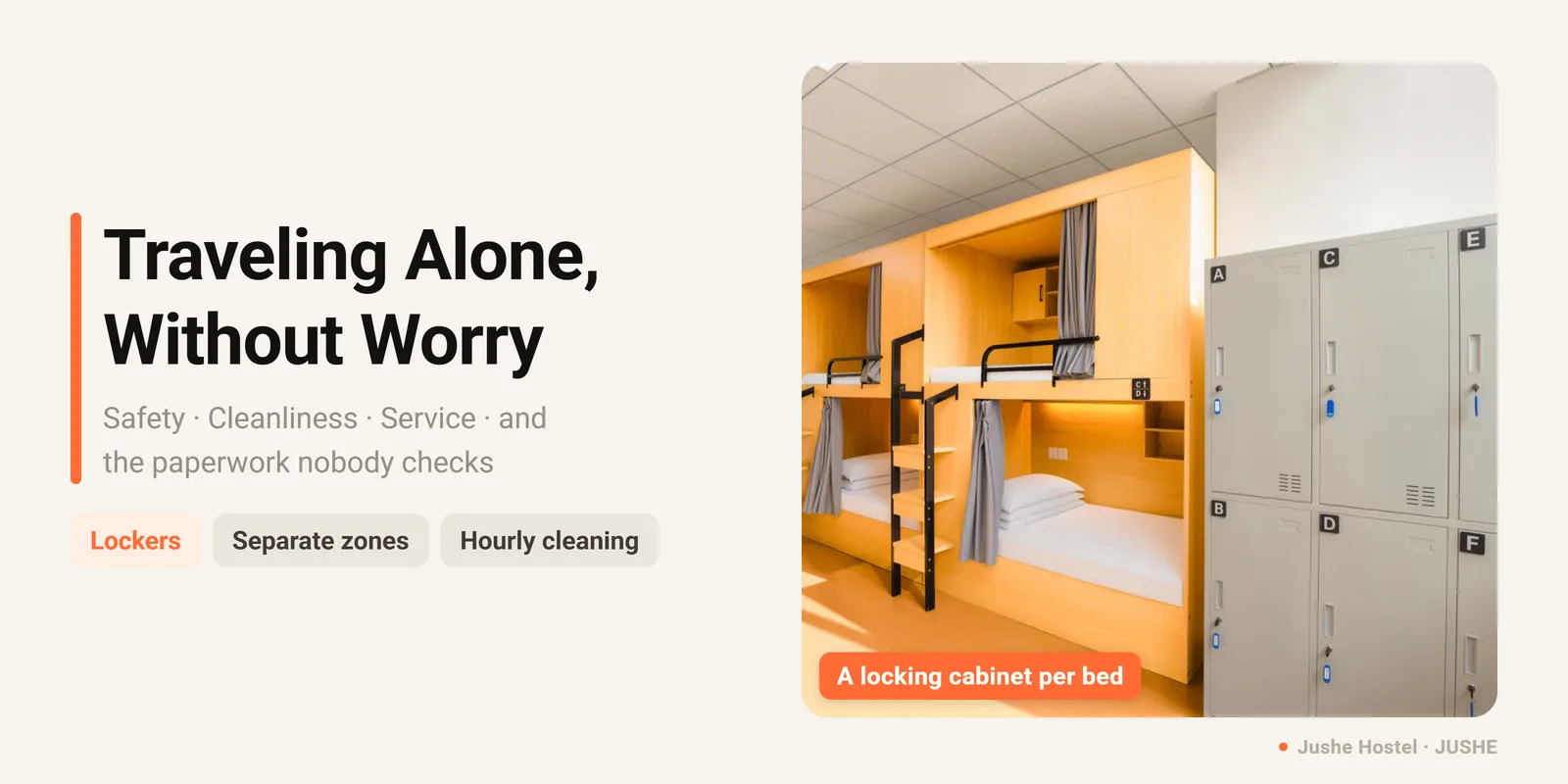
We get a lot of messages that sound like this: "Is it safe to stay in a hostel alone?" "Will my luggage go missing if I leave it in the room?" "Aren't shared rooms loud and dirty?"
Most of the people asking are young and getting ready to travel alone for the first time — an interview in another city, an internship somewhere unfamiliar, or just a trip they want to take by themselves. It is not that they cannot spare a few hundred RMB. What they are missing is an answer to "what happens if something goes wrong."
What Jushe Hostel does, in plain terms, is write that answer down in advance. We want people who are afraid to travel alone to feel they can. No sentimentality below — just safety, cleanliness, and service taken apart one at a time, and then the thing almost nobody examines but that separates the field more sharply than anything else: paperwork.
One. Safety: first solve "will my things go missing" and "will I be okay"
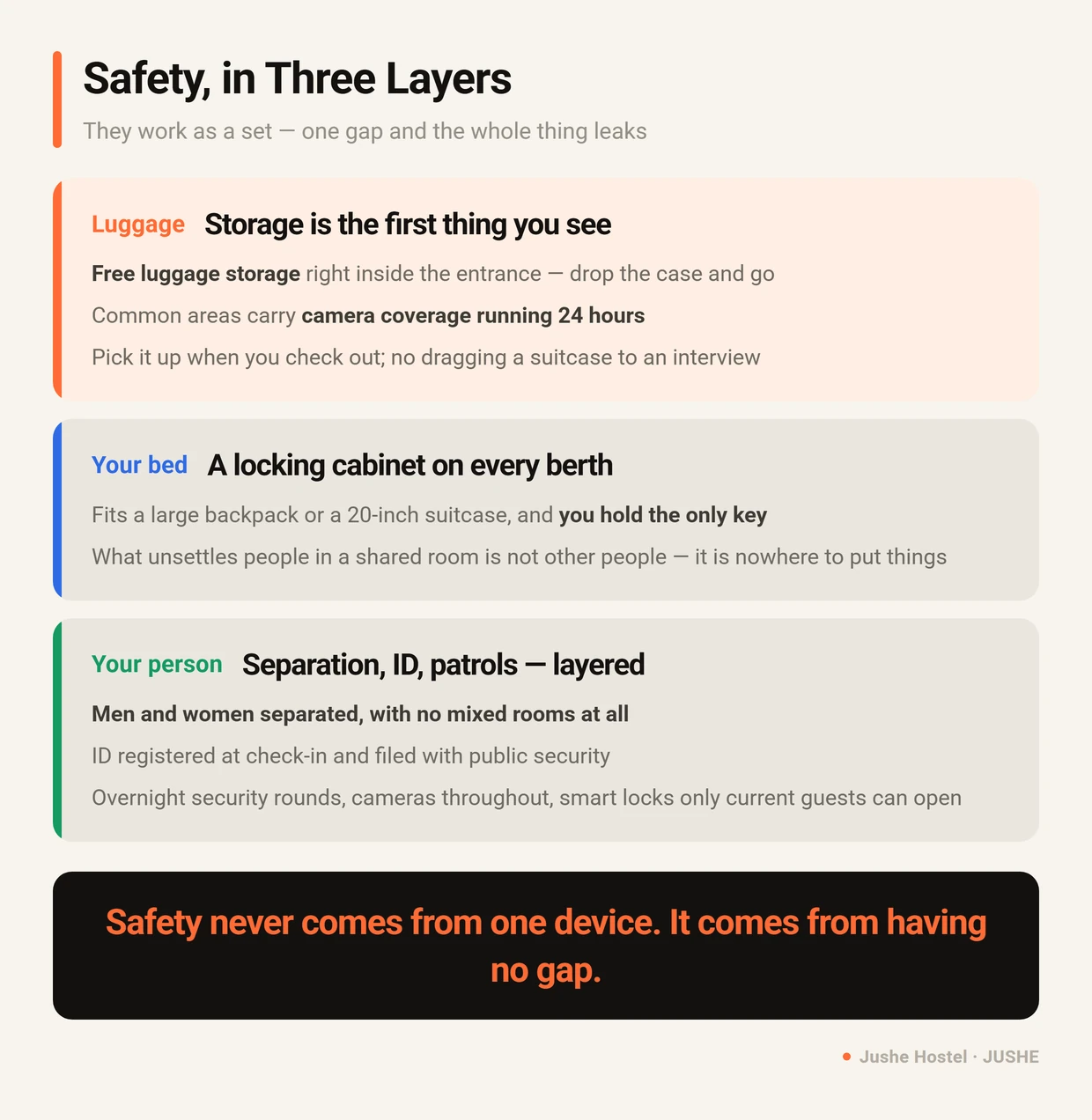
Nine-tenths of the anxiety about traveling alone lands on two concrete things: your luggage and your person. So that is where the design starts.
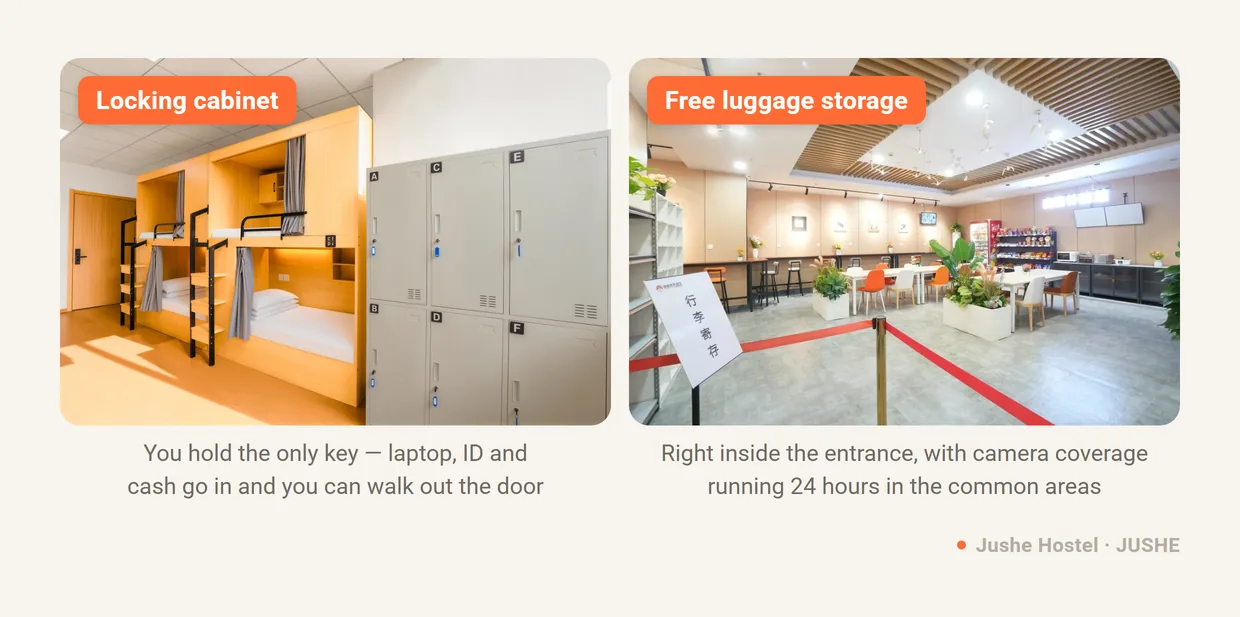
Luggage: you see the storage the moment you walk in. Dragging a 24-inch suitcase across a city is more exhausting than the interview itself. Jushe puts free luggage storage right inside the entrance. Check in, drop the case, and go out to interviews, errands, or job fairs without it for the rest of your stay, then pick it up when you check out. Common areas have camera coverage running 24 hours, so the case sits there and you are not thinking about it mid-interview.
Your bed: a locking cabinet for every berth. This is the single most important piece of hardware in a shared room. Every Jushe bed comes with its own locking storage cabinet big enough for a large backpack or a 20-inch suitcase, and you hold the only key. Laptop, ID, cash go in, and you can walk out the door. What actually unsettles people in a shared room is never "there are other people here" — it is "there is nowhere to put my things." Solve that and the rest gets easy.
Your person: separation, ID, and patrols, layered. Every Jushe location separates men and women, with no mixed rooms at all. At check-in the system registers your ID and files it with public security, so everyone sharing your room is a registered guest. There are overnight security rounds and camera coverage throughout, and rooms use smart locks with a code sent to your phone alongside the printed slip, so only current guests can open that door.
Every one of those sounds basic. But note the structure: they work as a set, and one gap ruins the whole thing. Cameras but no separation; separation but no ID check; ID checks but anyone can walk into the building — safety never comes from one device. It comes from having no gap.
Two. Privacy: pull the curtain and you have your own room
What puts people off shared rooms is not usually the price. It is the sense that not one inch of it belongs to them. We spent real effort here.
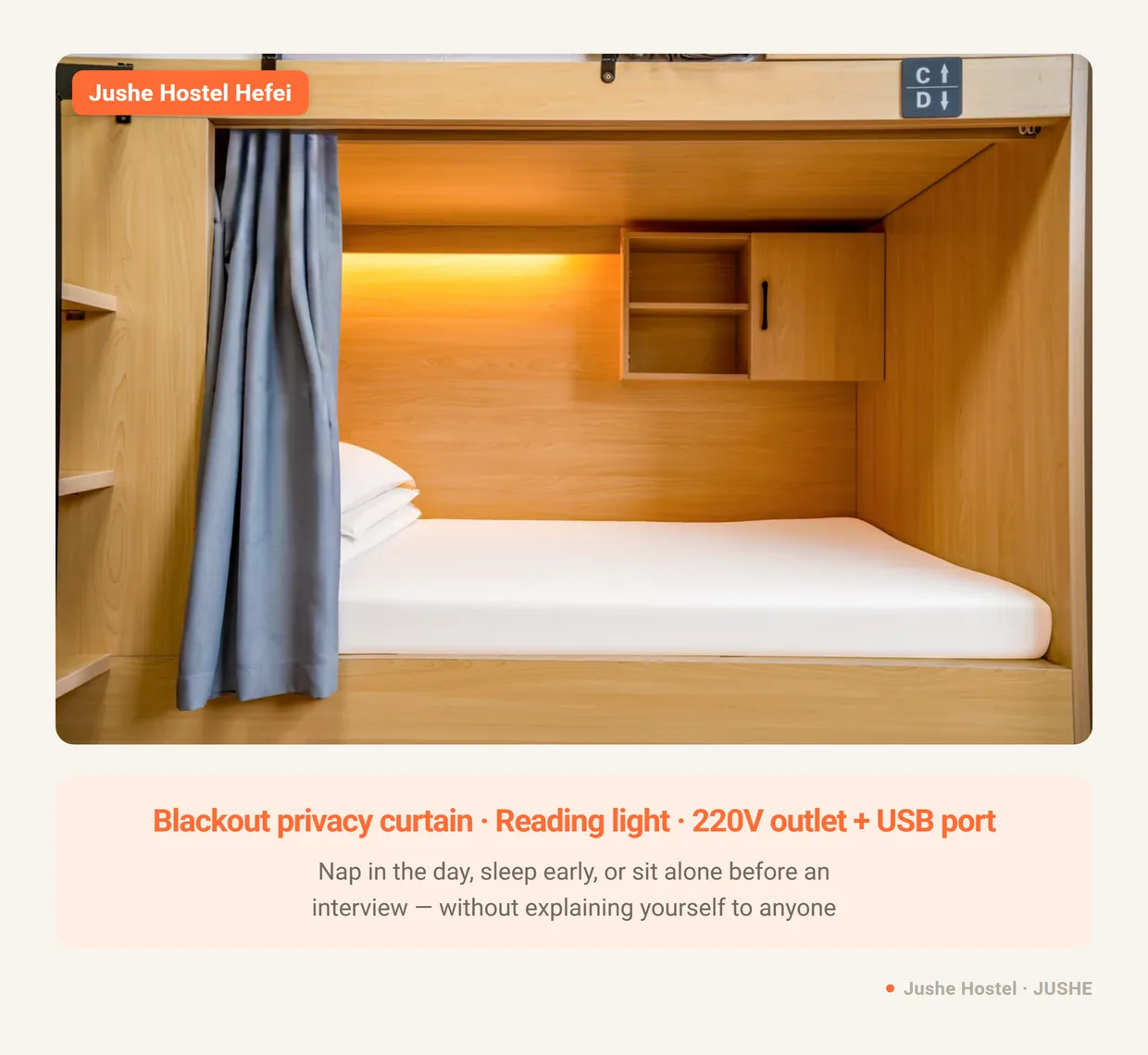
Every bed has its own privacy curtain with serious blackout material — pull it and nobody sees in, and the hallway and common-area lights do not reach you. It is not a sheet hung on a rail. It is a small room with only you in it. Napping during the day, going to bed early, sitting alone before an interview: none of it requires explaining yourself to anybody.
The head of the bed has everything it should: a 220V outlet and a USB port, so phone, laptop, and power bank charge at once and you are not climbing down at midnight to fight for a shared socket, plus an individual reading light, so someone coming in late switches on their own lamp instead of the ceiling light and waking the room. In a shared room, decency usually lives in details like that.
Outside the room, common areas have 24-hour hot and cold filtered drinking water. Shower areas are split by gender, with private stalls and hot water around the clock. Disposable toiletry kits, shampoo and body wash, and slippers are all free, so you arrive and you can simply live — nothing to buy.
Three. Cleanliness: a line where "close enough" is not allowed
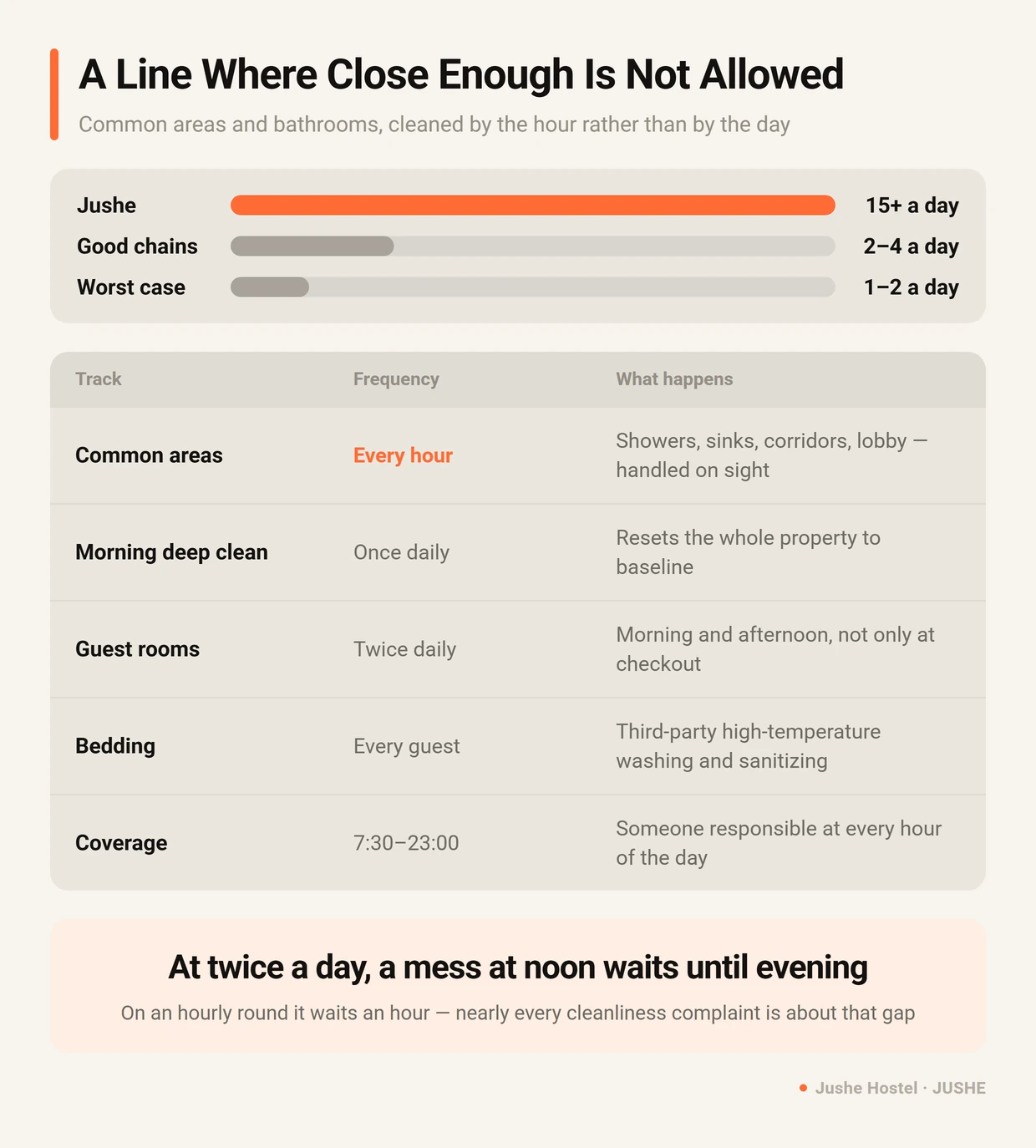
Cleanliness is where this business most often falls apart. It is not like location or price, which are visible and comparable. It is dozens of small repetitive tasks that have to get done whether or not anyone is watching.
Bedding is strictly changed for every guest. Sheets, duvet cover, pillowcase, the full set — not "it looks fine, one more night." Every guest gets bedding that was just put on. What comes off goes to a third-party specialist for high-temperature washing and sanitizing, rather than being scrubbed and hung out on site. Slippers are disinfected between guests as well.
Common areas and bathrooms are cleaned every hour. Each morning starts with a deep clean, and after that someone walks a round every hour: shower stalls, sinks, corridors, the lobby. Whoever spots a problem deals with it then, not at the next shift change. Over a day that comes to more than 15 cleaning passes.
From 7:30 a.m. to 11 p.m., someone is responsible for cleanliness at all times. Daytime it is the cleaning staff; the evening shift checks the bathrooms on the same hourly basis — an unflushed toilet, paper on the floor, handled on sight. Guest rooms run on a separate track: housekeeping cleans each room twice a day, morning and afternoon.
There is a reference point for that frequency. Among the better-run chain hostels in this category, the published standard for common-area cleaning is typically two to four times a day. Ours runs hourly. The difference is not how the standard reads. It is how long the gap between two passes is. At twice a day, a mess at noon waits until evening. On an hourly round, it waits an hour at most. Nearly every cleanliness complaint in hostel reviews is really a complaint about that gap.
That is why we are willing to spend here. A converted-apartment hostel in a residential building, where one person runs the front desk, the cleaning, and the checkouts, physically cannot staff an hourly rotation. Whether it can be done comes down not to attitude but to whether there is enough chain scale to carry the payroll.
Making cleanliness a standard rather than a mood is genuinely expensive. But if that line slips, every piece of safety design above loses its credibility — nobody believes a hostel with a smelly bathroom is managing its cameras and door locks properly.
Four. Service: somebody is here 24 hours, so a strange city is less strange
Safety and cleanliness are the floor. Service decides whether the stay is any good.
A manager on site 24 hours. Arriving at 3 a.m., needing a resume printed, an air conditioner that will not cool, a charger left behind — WeChat or a phone call reaches somebody immediately. Jushe's managers do more than lodging: they volunteer job-search information and local guidance, and they refer guests to gig work for free. For someone who just got off a high-speed train without a single local number in their phone, having someone to ask is itself a form of safety.
A free study room. Every location has one, with individual desks and office chairs. Writing a resume, applying, sitting an online class, taking a remote interview, studying for an exam — all of it has somewhere quiet and well lit, and you are not buying a 30-RMB coffee for the seat.
Self-service check-in throughout. Book online, register with your ID at the kiosk, get the door code on the slip and by text at the same time, let yourself in. Any hour, any day — arriving at three in the morning does not mean knocking on a locked front desk.
Five. The threshold nobody looks at: fire safety, ID registration, health certificates
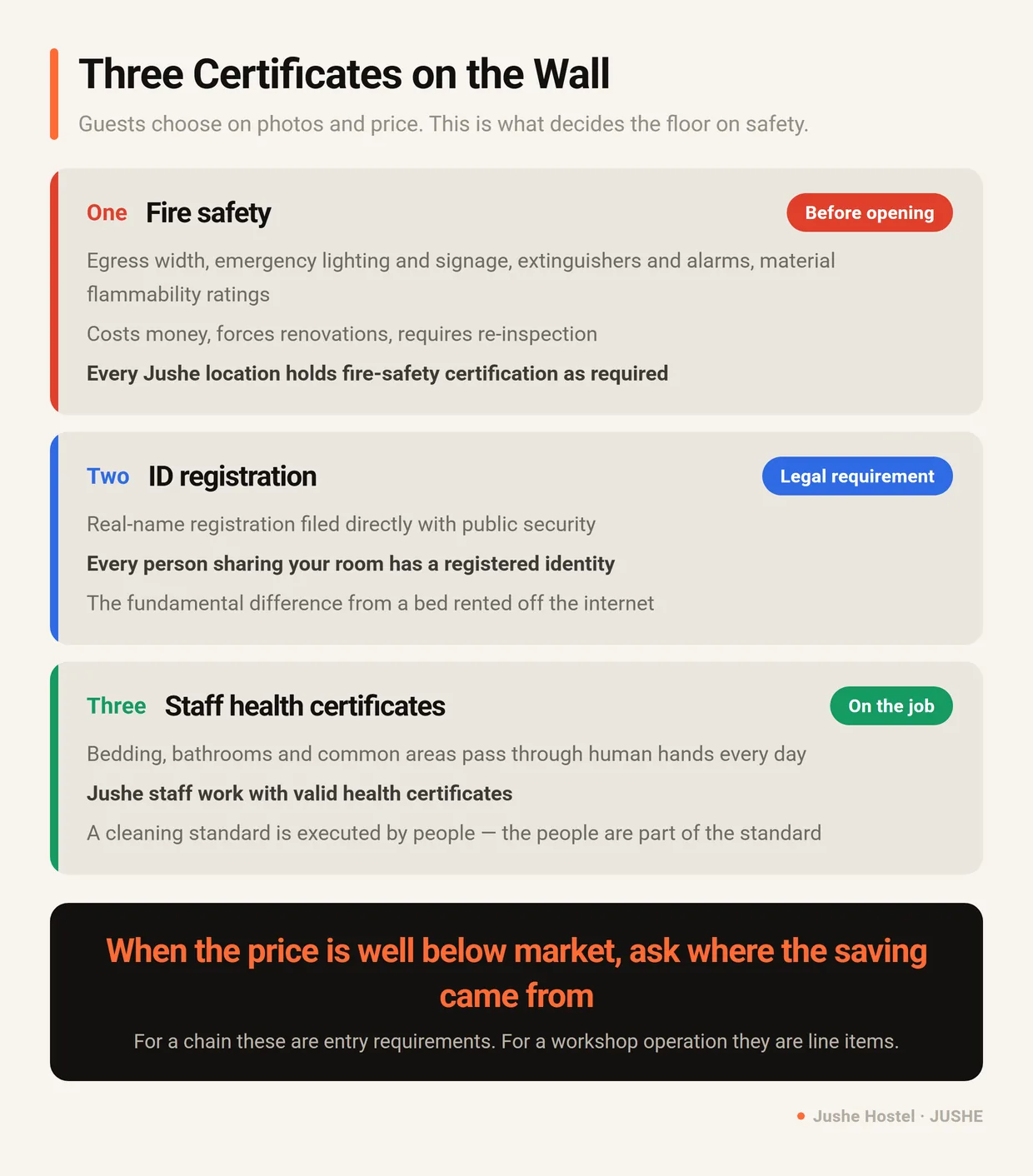
Everything above is visible. Here is the part you will probably never check, and the part that most determines the floor on safety — credentials.
Guests choose a hostel on photos, price, and rating. What actually determines whether a hostel is safe is a few pieces of paper on the wall.
The first is fire safety. Hostels are almost always inside larger buildings: shared rooms, bunk beds, people sleeping in one place. If something happens, all you have is the escape route and the emergency lighting. This is not a form you fill in — it covers the width of egress corridors, emergency lighting and signage, the specification and maintenance of extinguishers and alarms, and the flammability rating of the finish materials. It costs money, it forces renovations, it requires re-inspection. Every Jushe location holds fire-safety certification as required, cleared before opening rather than patched in afterward.
The second is ID registration. Real-name registration is a legal requirement in the lodging industry, filed directly with public security. The benefit is plain: every single person sharing your room has a registered identity. That is the fundamental difference between a hostel and a bed rented off the internet, where you have no idea who is coming through the door at 2 a.m.
The third is health certification. Bedding, bathrooms, and common areas pass through human hands every day. Jushe staff work with valid health certificates, which is the precondition for "changed for every guest" and "cleaned every hour" being real. A cleaning standard is ultimately executed by people, and the people executing it are part of the standard.
Those three certificates are the hardest and least discussed barrier in this business. They are expensive, they are a nuisance, and you cannot put them on sale. Which is exactly why a great many individually run, subdivided hostels do not have them and do not plan to — skipping that cost is how the price gets down to the number that looks so appealing.
So when you see a rate well below the market, it is worth asking one more question: where, specifically, did that saving come from? For a chain brand these are entry requirements. For a workshop operation they are line items. One has to; one can skip it. That is the whole difference.
We have put the credential questions into the FAQ, and our full commitment on safety and cleanliness is on the About Jushe page.
Six. Inexpensive, but not cut-rate
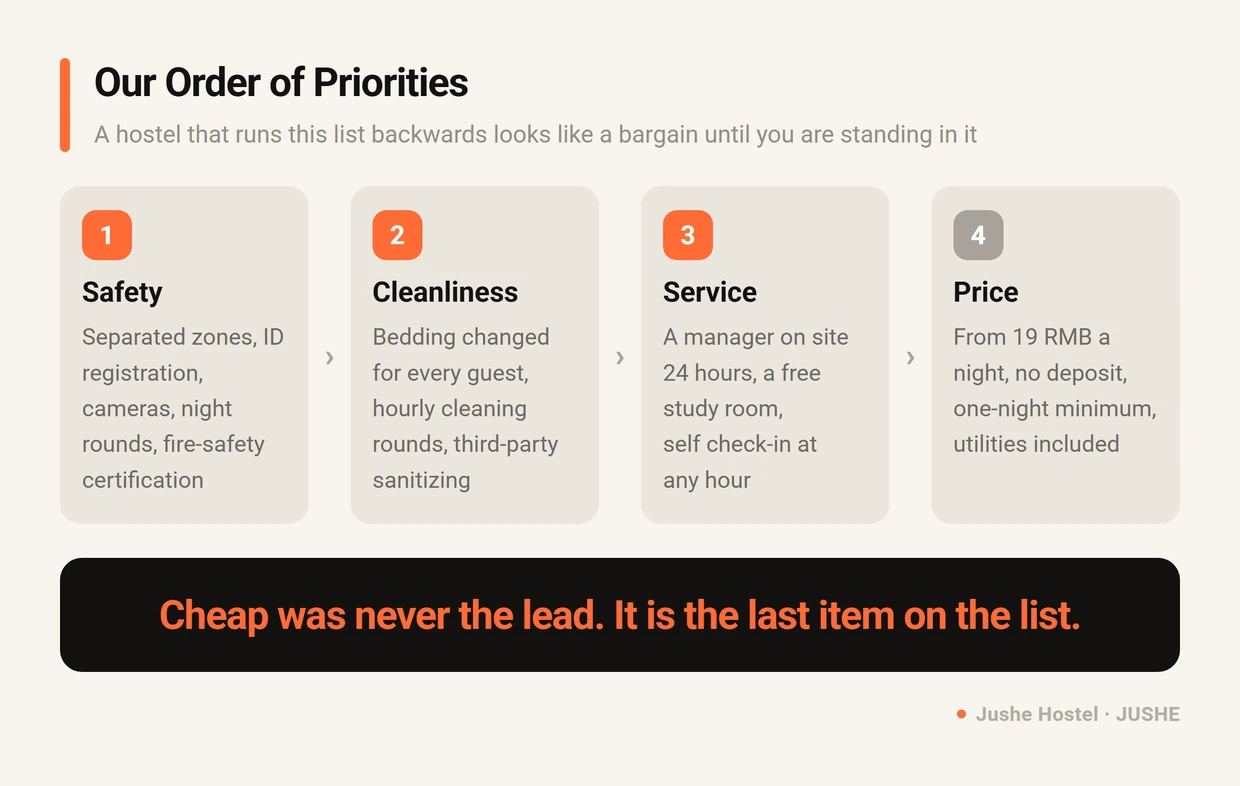
Once all of the above is done, it is worth talking about price.
Jushe is from 19 RMB a night, no deposit, a one-night minimum, utilities included, billed daily, weekly, or monthly, with weekly and monthly rates for longer stays. For a job seeker, an intern, or someone studying on a tight budget, that price means you can get settled first and then take your time choosing a job worth having, instead of letting rent make the decision for you. We ran that arithmetic in long-term rental vs. short stay.
But cheap was never our lead. Our internal order of priorities is explicit: safety first, then cleanliness, then service and convenience, and price last. A hostel that runs that list backwards looks like a bargain right up until you are standing in it.
Seven. One last thing: you will not really be alone
One point that has nothing to do with any of the equipment.
A lot of people check into their first hostel bracing themselves, and a few days later do not want to leave — because the people sitting in the common area are in more or less the same spot they are: interviewing tomorrow, testing next week, three days into a new city. An offhand "you here for interviews too?" in the lobby can take a whole day of tension off someone.
People have picked up referrals here. People have found someone to ride to the exam hall with. And some have just sat at the long table late at night listening to a stranger describe his hometown. The most valuable thing a hostel has is not the bed. It is that going somewhere alone stops meaning carrying it alone.
If you have ever skipped a trip because you did not dare go by yourself — safety, cleanliness, and service are three things we have already thought through for you. The last step is yours.
First time going somewhere alone? Jushe Hostel is from 19 RMB a night, no deposit, a one-night minimum, 24-hour self check-in, with gender-separated zones, ID registration, bedding changed for every guest, and free luggage storage. Bring your ID and just show up.