
A New Cleaning Benchmark: Two Full-Time Cleaners per Location, Hourly Rounds, Nights Included
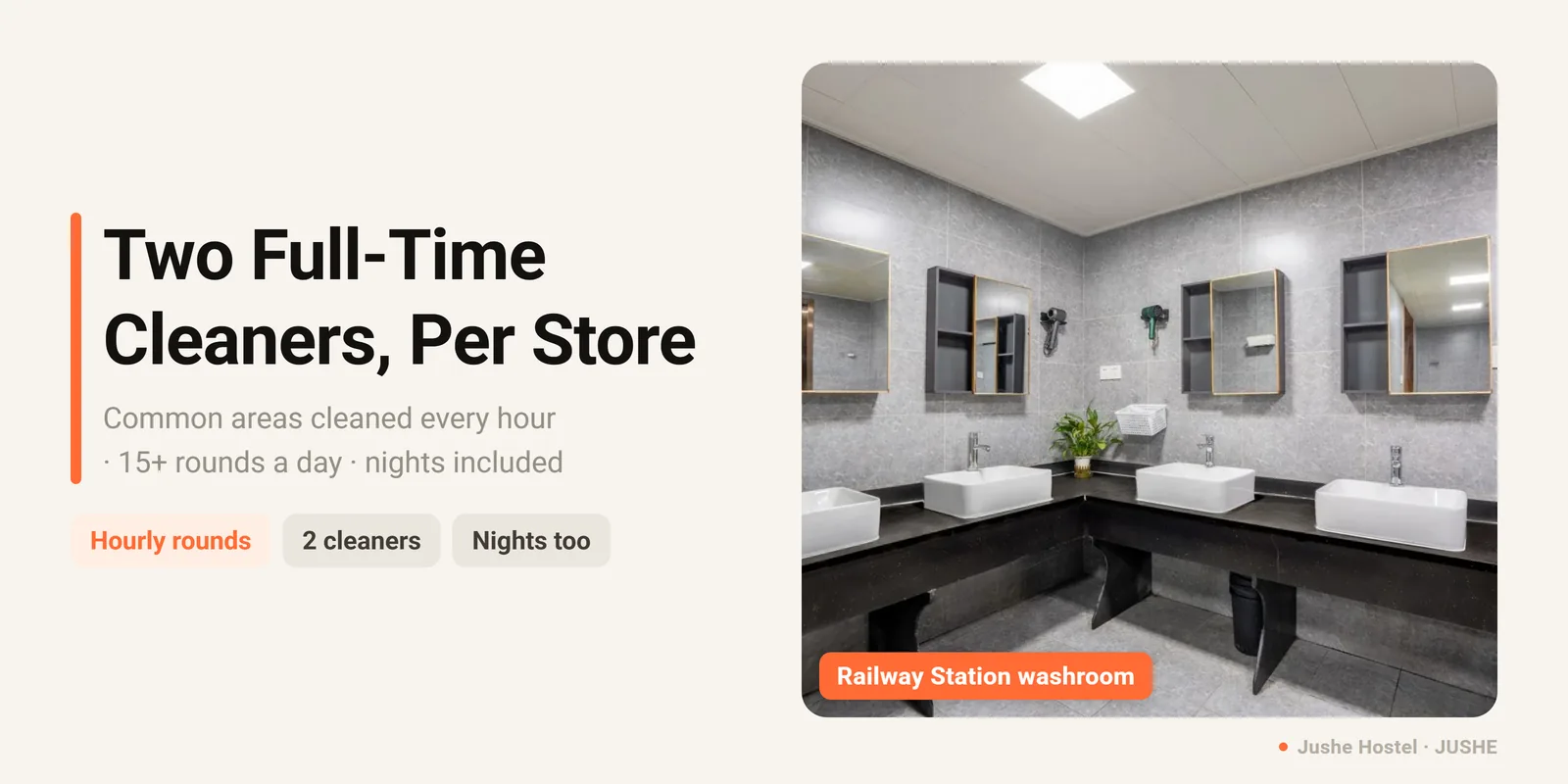
Here is a fact that is not flattering to this industry: a large share of negative hostel reviews are about cleanliness.
And the wording is remarkably consistent — "the bathroom smelled," "hair all over the sink," "nobody touched the toilet for hours." You almost never see someone complain that "they only clean twice a day." What people complain about is always the moment they personally walked in on.
The distance between those two sentences is the entire subject of this post. Cleanliness is not a standards problem, it is a frequency problem — and frequency is not an attitude problem, it is a staffing problem. Jushe Hostel rebuilt all three layers, and below is each one spelled out, including how many people it takes.
One. The numbers first: more than 15 times a day
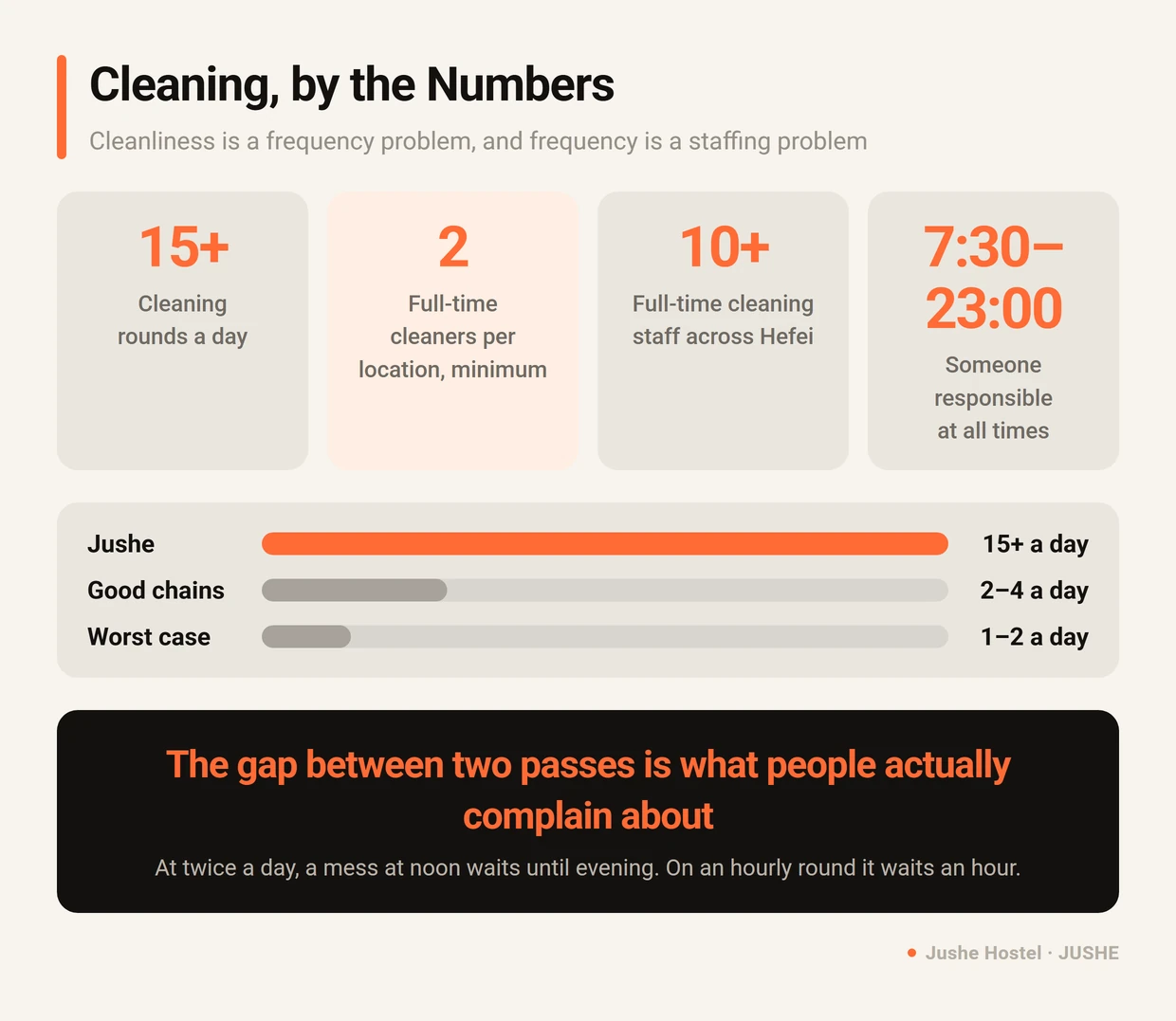
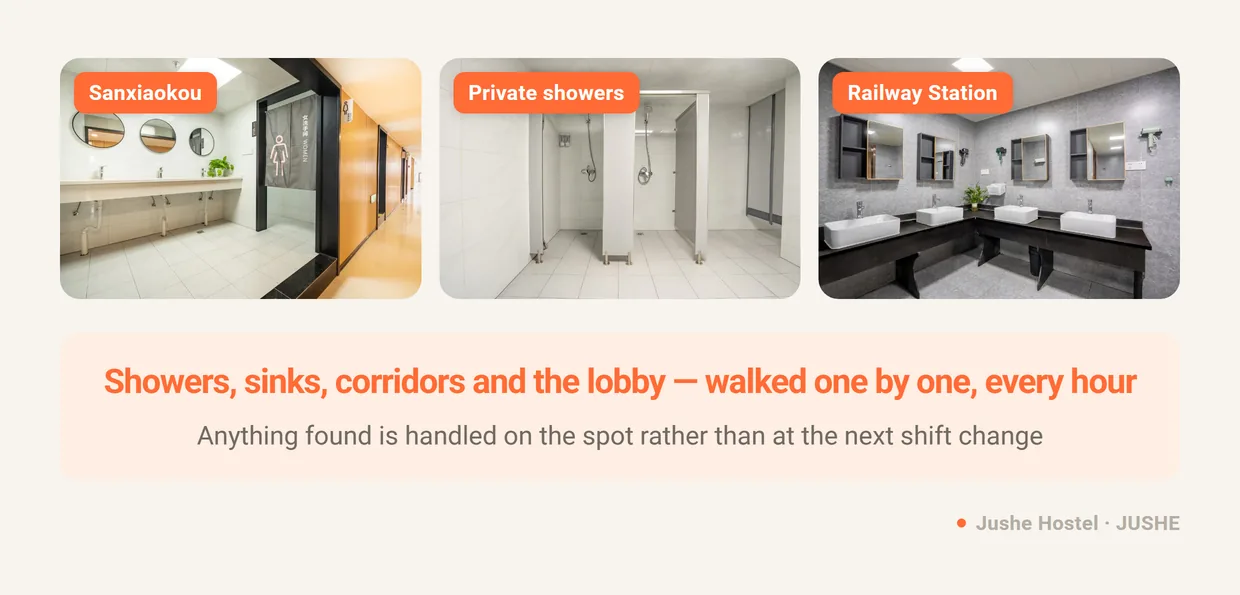
Here is how cleaning works in Jushe's common areas and bathrooms. One deep clean every morning, then an inspection-and-clean round every hour after that — shower stalls, sinks, corridors, and the lobby walked one by one, with anything found handled on the spot instead of at the next shift change. Over a day that comes to more than 15 cleaning passes.
From 7:30 a.m. to 11 p.m., someone is responsible for cleanliness at every hour of the day. Not a rota printed and taped to a wall — somebody actually walks it, every hour.
For reference: among the better-run chain hostels in this category, the published standard for common-area cleaning is typically two to four times a day. That is already a respectable number here, and plenty of independent properties do not manage it.
But the difference is not how well the standard reads. It is how long the gap between two passes lasts. At twice a day, a mess at noon waits until evening. On an hourly round, it waits an hour at most. Every one of those reviews at the top of this post is a complaint about that gap. What we set out to do was hold the gap under an hour.
Two. At least two full-time cleaners per location — the foundation of all of it
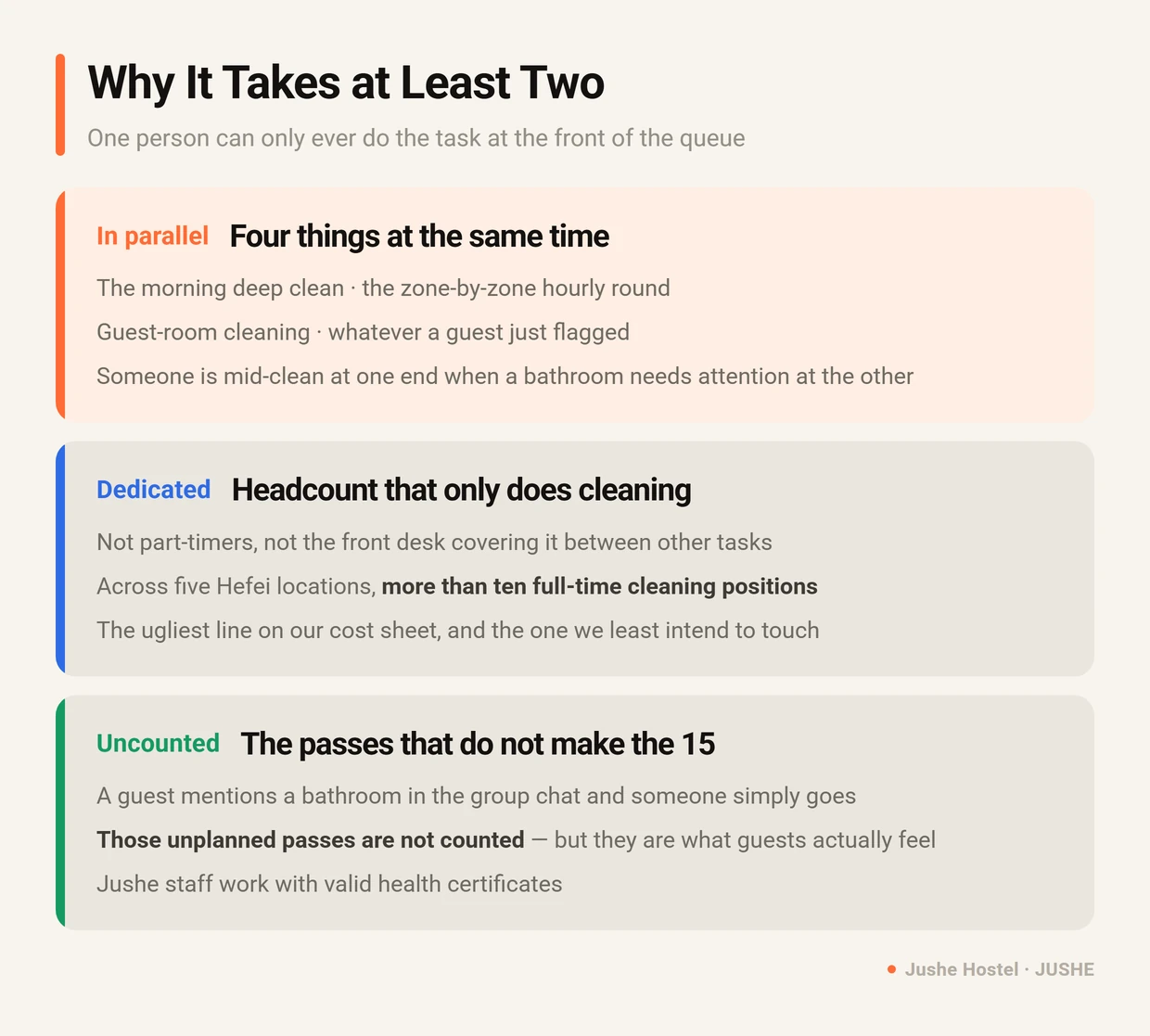
That frequency is just a promise on its own. Whether it gets delivered comes down to one thing: whether there are people whose only job is this.
Every Jushe location staffs at least two full-time cleaners — not part-timers, not the front desk covering it between other tasks, but headcount that exists on its own and does nothing but cleaning. Across our five Hefei locations, that is more than ten full-time cleaning positions. It is the ugliest line on our cost sheet and the one we least intend to touch.
Why "at least two"? Because one person cannot produce an hourly rotation. Within the same stretch of time, four things happen in parallel: the deep clean, the zone-by-zone round, guest-room cleaning, and whatever a guest just flagged. If someone is in the middle of cleaning the washroom area and a guest reports a dirty bathroom at the other end, somebody else has to go now. A location with one person can only ever do the task at the front of the queue, and everything else quietly becomes "in a bit."
In practice our staff run more rounds than the rota calls for. Often a guest mentions in the group chat that a bathroom needs attention and someone simply goes and handles it — those unplanned passes are not counted in the 15, but they are the part guests actually feel.
One more precondition that is easy to overlook: Jushe staff work with valid health certificates. Bedding, bathrooms, and common areas pass through human hands every day, and a cleaning standard is ultimately executed by people, so the people executing it are part of the standard.
Three. What a day of cleaning actually looks like
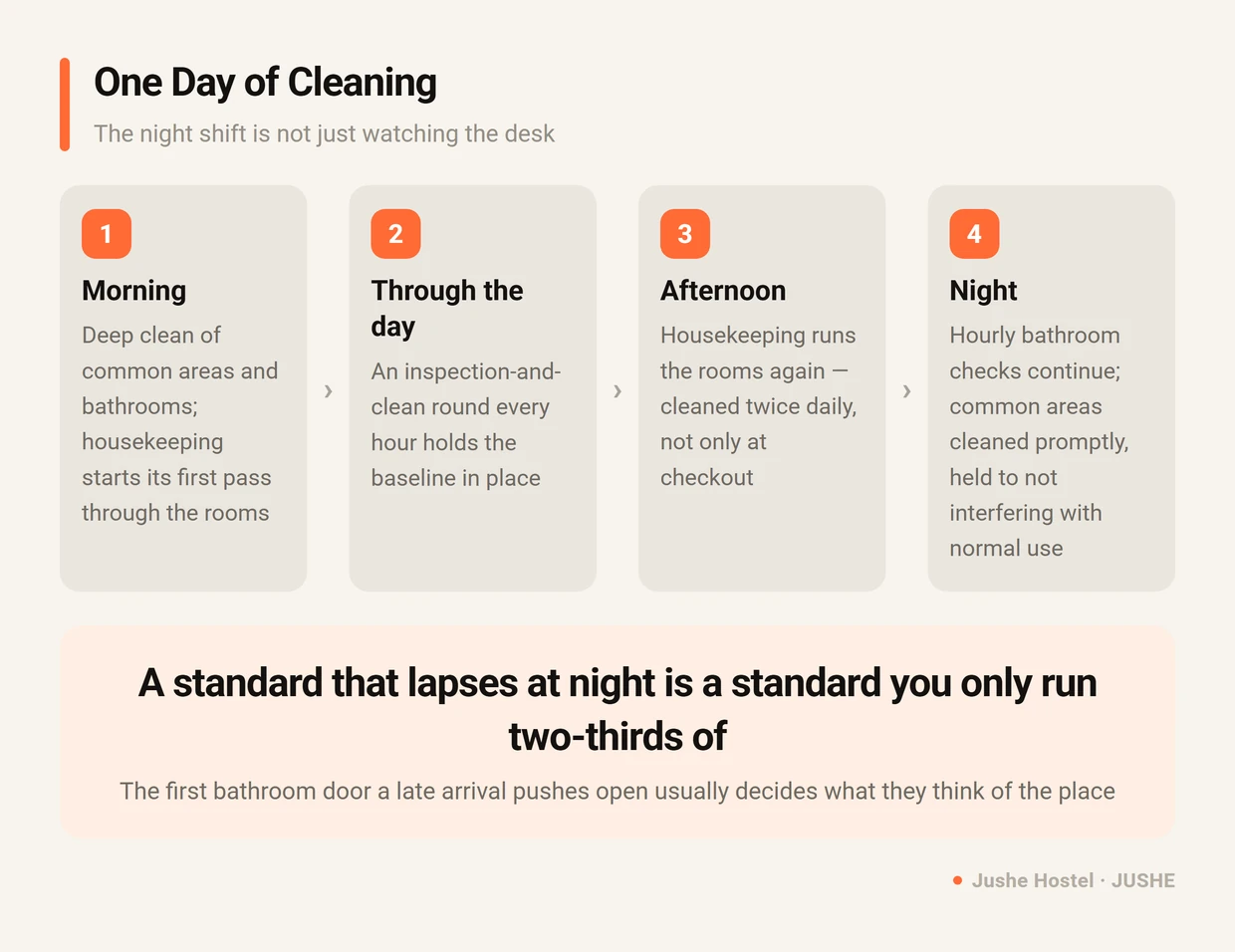
Laid out across a day, it looks like this.
Morning is the heaviest round: a deep clean of the common areas and bathrooms, while housekeeping starts its first pass through the guest rooms. When that is finished, the whole property is back at baseline.
Through the day, an inspection-and-clean round every hour holds that baseline in place. In the afternoon, housekeeping runs the guest rooms again — so a room at Jushe is cleaned twice daily, morning and afternoon, rather than only when someone checks out.
At night the hourly bathroom checks continue into the small hours. That part gets its own section below.
Four. The night shift is not just watching the desk
At a lot of hostels the night shift means sitting at the front desk waiting to check in late arrivals and doing nothing else. Jushe's night staff have one duty written explicitly into the role: keep the common areas and bathrooms clean, promptly.
The reason is practical. Hostel guests keep far more scattered hours than hotel guests — someone gets off a train at 1 a.m., someone comes back from working late, someone sits in the lobby until two. A standard that holds during the day and lapses at night is a standard you are only running two-thirds of.
So the night shift checks the bathrooms on the same hourly basis: a toilet that was not flushed properly, paper on the floor, a sink left in a mess — spotted and dealt with. The bar is that nothing interferes with normal use. For someone arriving in the middle of the night, the first bathroom door they push open usually decides what they think of the whole property.
There is no technique to this. It is purely a question of whether anyone does it and whether you are willing to staff the shift. We staffed it.
Five. Cleanliness is more than sweeping: four independent tracks
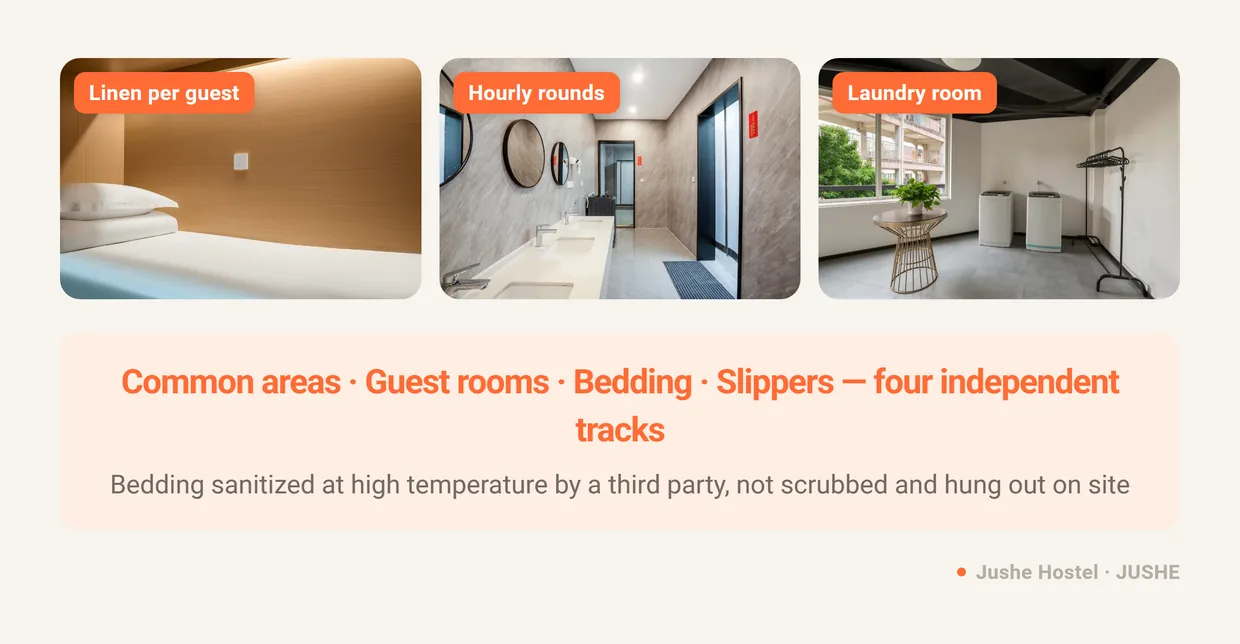
Cleaning frequency is only one of them. Jushe's standard runs on four parallel tracks, and if any one slips the other three are wasted.
Track one, common areas and bathrooms: one deep clean each morning, then an inspection-and-clean round every hour, more than 15 rounds a day, with someone responsible from 7:30 a.m. to 11 p.m. and hourly checks continuing on the night shift.
Track two, guest rooms: housekeeping cleans each room twice a day, morning and afternoon, holding baseline in between.
Track three, bedding: strictly changed for every guest. Sheets, duvet cover, and pillowcase as a full set — not "it looks fine, one more night." What comes off goes to a third-party specialist for high-temperature washing and sanitizing, not scrubbed and hung out on site.
Track four, slippers: disinfected between guests. It is the least conspicuous item on the list and the easiest to skip, which is exactly why we list it separately.
The hardware follows the same logic: shower areas split into men's and women's zones, private stalls with 24-hour hot water, gender-specific QR-code washers and dryers, and free disposable toiletry kits, shampoo and body wash, and slippers.
Six. Why many hostels cannot do this: it is a cost problem, not a character problem
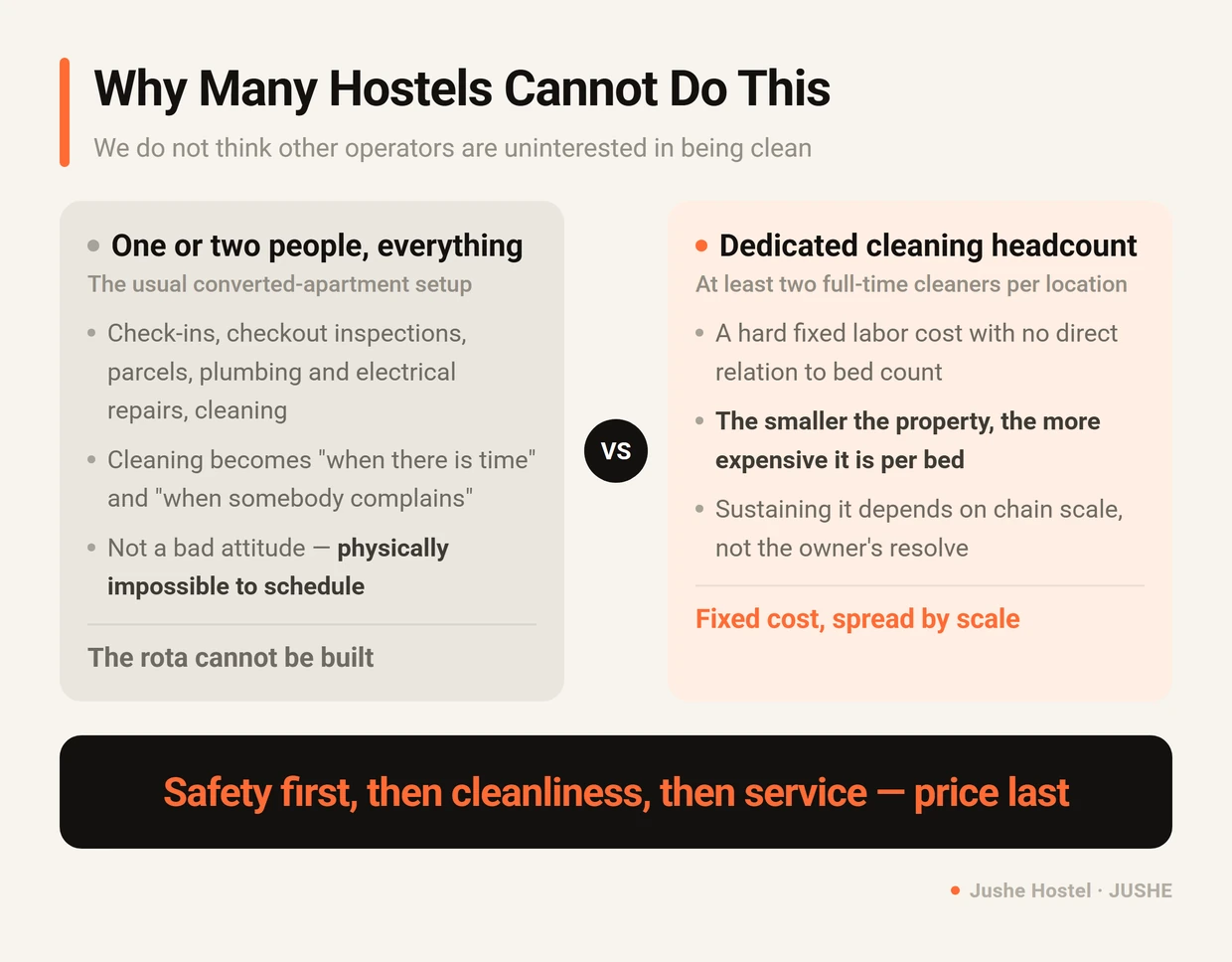
We do not think other operators are uninterested in being clean. Most of the ones that fall short simply cannot build the rota.
A converted-apartment hostel in a residential building typically has one or two people covering everything: check-ins, checkout inspections, parcels, plumbing and electrical repairs, and cleaning. Under that structure, cleaning can only ever be "when there is time" and "when somebody complains." That is not a bad attitude. It is physically impossible to schedule.
Full-time cleaners are a hard fixed labor cost with no direct relationship to bed count: the smaller the property, the more expensive that cost is per bed. So whether an operator can sustain at least two full-time cleaners per location year after year comes down not to the owner's resolve but to whether there is enough chain scale to spread that fixed cost.
Which brings us back to the order of priorities we keep repeating: safety first, then cleanliness, then service and convenience, and price last. A property that runs that list backwards looks like a bargain right up until you are standing in it. We went through that priority order in full in why you can trust us when you travel alone.
Seven. Publishing the line
Anybody can write a cleaning policy on a wall. Only two things can actually be checked: the staffing table and the shift rota.
So here they are: at least two full-time cleaners per location; common areas and bathrooms deep cleaned each morning, then inspected and cleaned every hour, more than 15 rounds a day; someone responsible from 7:30 a.m. to 11 p.m.; the night shift cleaning common areas and bathrooms as well; guest rooms cleaned twice a day, morning and afternoon; bedding changed for every guest and sanitized at high temperature by a third party; slippers disinfected between guests.
Publishing that has a price — once it is written down, we have to deliver it, and if we do not, a guest will tell everyone in a review the next day. But that is exactly why we are willing to publish it: turning a standard into a line that can be checked is how the whole category's floor rises a notch.
More questions about cleaning and facilities are collected in the FAQ, and our full commitment on safety and cleanliness is on the About Jushe page.
If you are choosing a hostel to stay in for a while, do not go by the photos. Ask how many full-time cleaners they have and how many times a day the common areas get cleaned. The answer will tell you more than any marketing copy.
Want to see for yourself? Jushe Hostel's five Hefei locations each staff at least two full-time cleaners, with common areas and bathrooms inspected and cleaned every hour, more than 15 rounds a day, and bedding changed for every guest and sanitized at high temperature by a third party. From 19 RMB a night, no deposit, one-night minimum, 24-hour self check-in.