
Hostel 2.0: From a Bed to a Way of Living
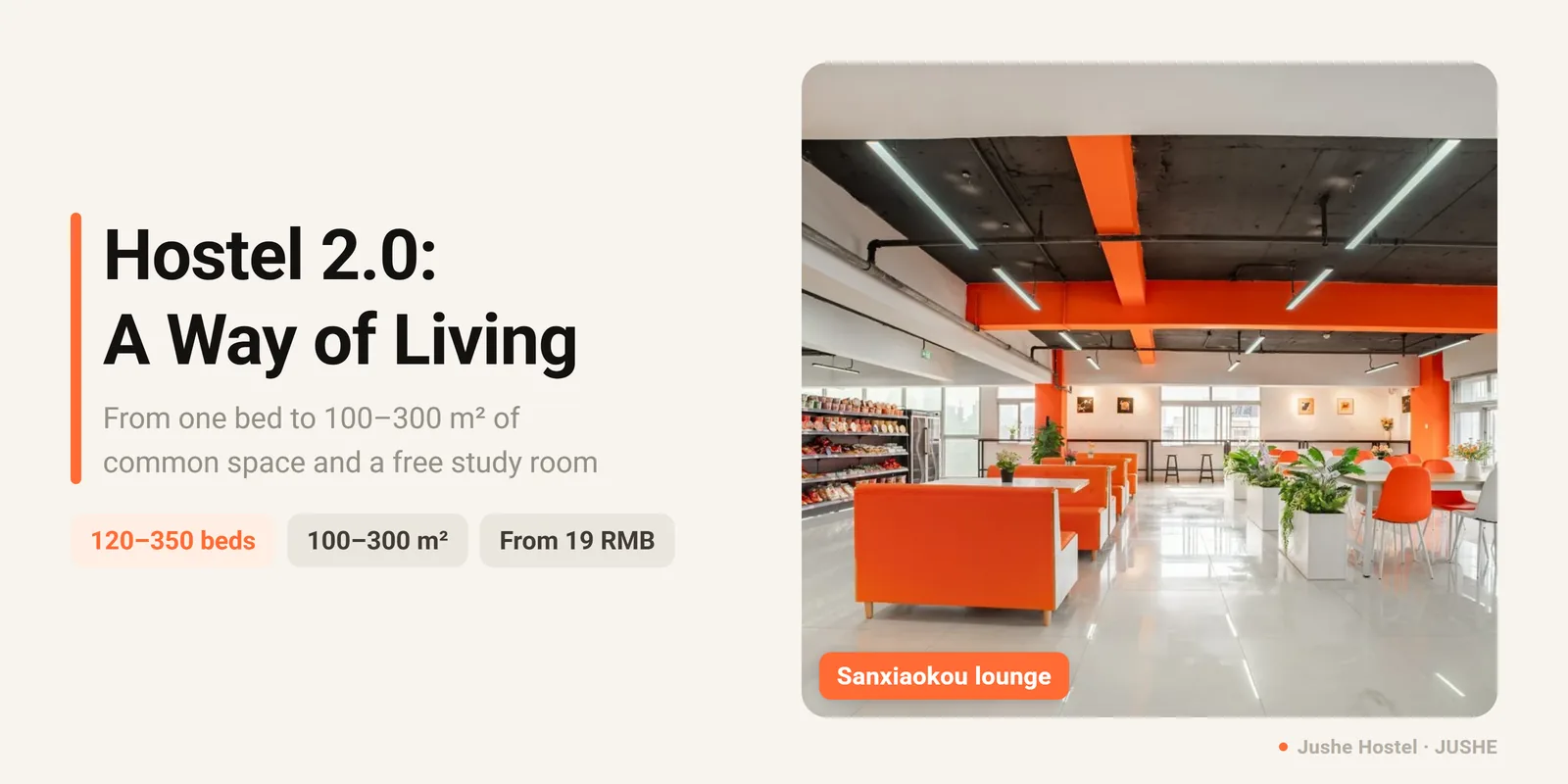
For the past decade and a half, youth hostels in China have mostly been stuck on the same version: one room, a few bunk beds, a corridor. You push the door open, fall asleep, and leave at dawn. Cheap was the only selling point and crowded was the accepted price. Call that Hostel 1.0. It solved exactly one problem: a bed for tonight.
But the young people checking in today stopped being travelers passing through a long time ago. They are job seekers from other cities, students preparing for exams, interns, freelancers, people posted here for a short project. They stay for weeks, sometimes months, and what they need is not a bed. It is a stretch of time in which they can live, work, and be around people like a normal person.
What Jushe Hostel is trying to do is push the category from 1.0 to 2.0 — from a bed to a way of living.
What Hostel 2.0 means: three shifts at once
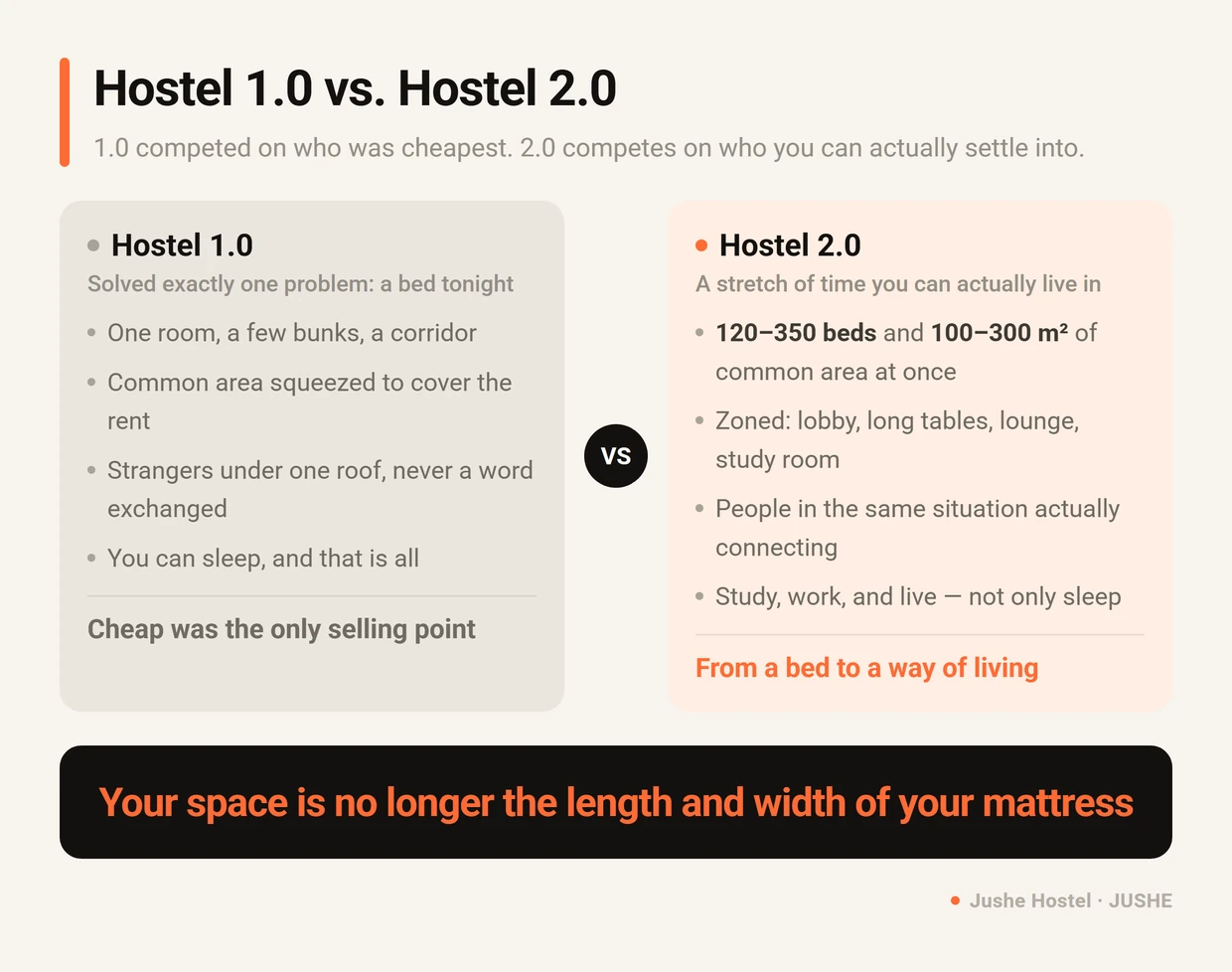
If 1.0 competed on who was cheapest, 2.0 competes on who can actually get a young person to settle in. Our answer comes in three shifts.
Space — from squeezing the common area to cram in beds, to running large bed counts and oversized common areas at the same time.
Social — from strangers sleeping separately, to people in the same situation actually connecting.
Function — from a place you can only sleep, to a place you can study, work, and live.
These are not three slogans. They are build specifications every Jushe location is held to.
The space shift: 120–350 beds is what makes a community possible
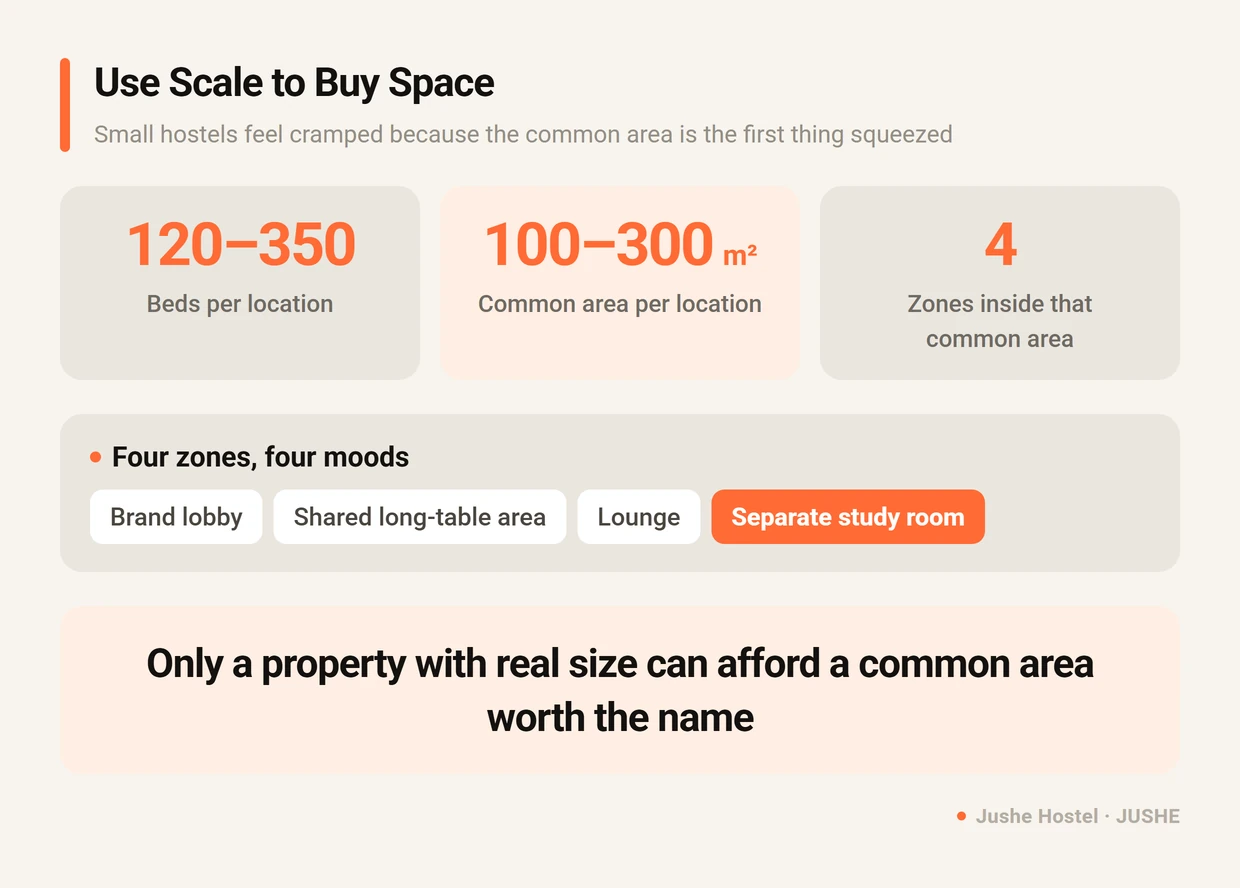
A single Jushe location runs 120 to 350 beds, well beyond the category norm, and that scale is the foundation the whole 2.0 model rests on.
Most people's first reaction is that more beds must mean more crowding. It is the opposite. Small traditional hostels feel cramped because total floor area is limited, so covering the rent means squeezing the common area again and again until there is not even a table you can eat dinner at. We go the other way: use scale to buy space, and use space to buy experience. Only a property with real size can afford a common area worth the name.
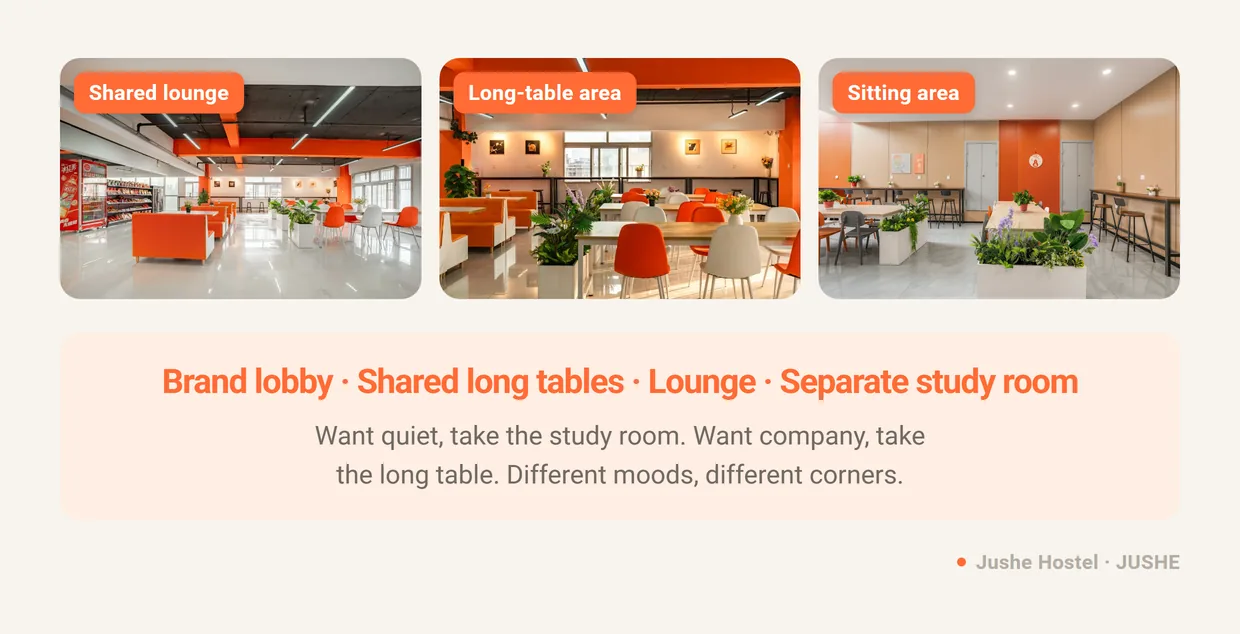
So what you get at Jushe is 100–300 m² of common area, and not one empty hall either — it is deliberately divided into zones: a brand lobby, a shared long-table area, a lounge, and a separate study room. Want quiet, go to the study room. Want company, sit at the long table. Want to curl up and stare at nothing, take the lounge. Whatever mood you are in, there is a corner for it.
That is the most visible thing about 2.0: the space you live in is no longer the length and width of your mattress.
The social shift: sharing a roof should actually connect people
The most valuable asset a hostel has was never the beds. It is the people. In the 1.0 era that asset was completely squandered — everyone under one roof, nobody exchanging a word.
We rebuilt the social side on purpose. The long-table area is a natural icebreaker: at eight or nine at night there will be five or six people at one table, someone editing a resume, someone reading interview notes, someone just back from a final round. Information moves on its own here — who is hiring, which recruiter is straight with you, which metro line commutes fastest, which place downstairs is cheap and good. No guide on the internet contains any of that.
The people at Jushe are mostly in the same phase of life: working somewhere that is not home, in the middle of a transition, nervous about what comes next and unwilling to give up on it. "So it is not just me grinding through this" — anyone who has stayed knows how much that sentence carries.
All of which depends on knowing where the line is. Jushe's common areas encourage conversation; the rooms protect quiet strictly. Every bed has its own privacy curtain, nights stay quiet, and anyone who needs to take a call or a voice chat goes out to the lounge. Loud where it should be loud, silent where it should be silent — that is what mature social design looks like. The etiquette details are in your first hostel stay.
Study space: making a free study room standard equipment
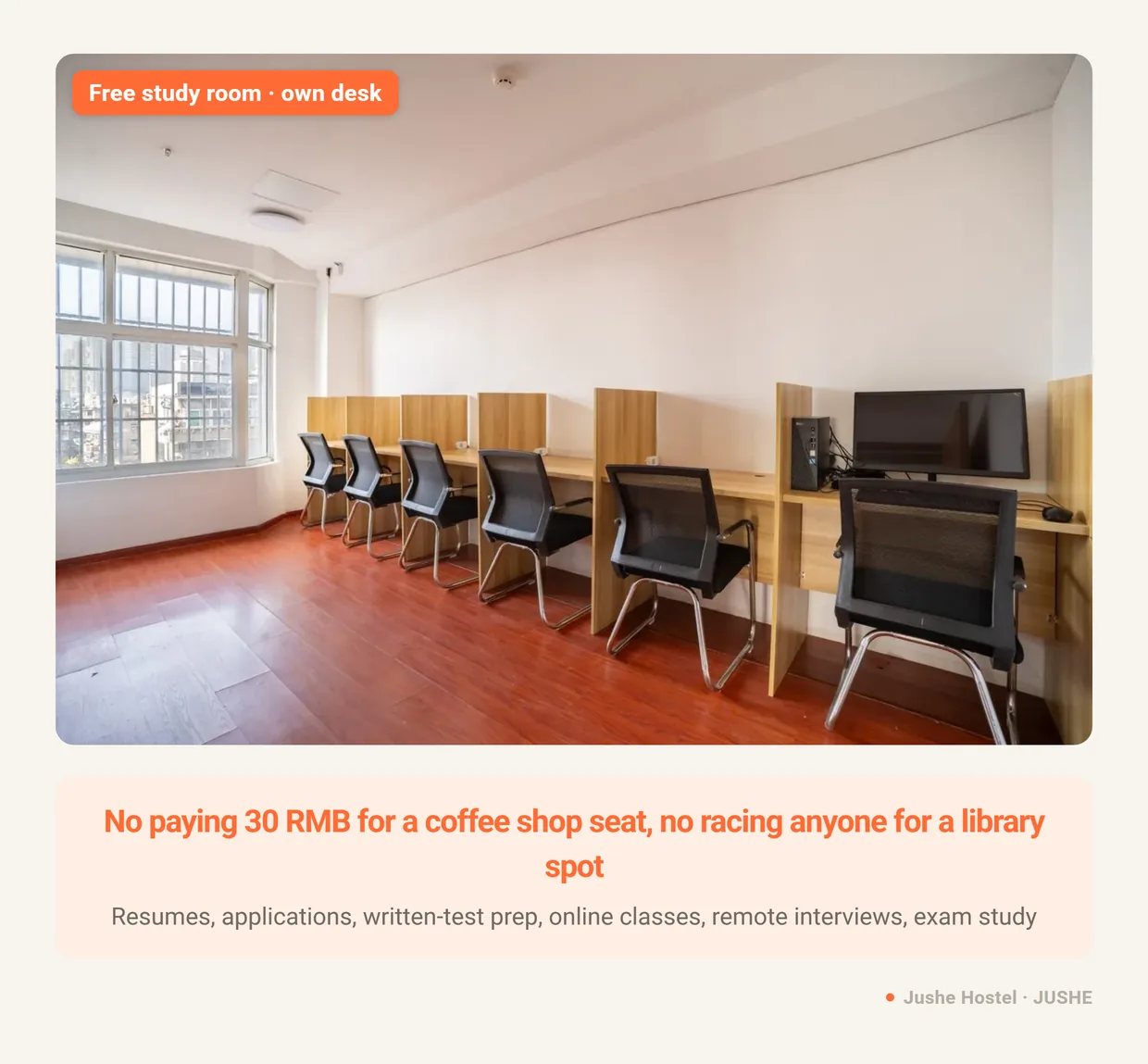
This is the thing we moved on earliest in the category, and the piece of the setup we are proudest of: every location has a free study room.
It has individual desks and real office chairs, not two tables shoved into a corner of the lobby as a gesture. Writing a resume, applying for jobs, prepping for a written test, sitting an online class, taking a remote interview, studying for the civil service or postgraduate exams — all of it has somewhere quiet, well lit, and uninterrupted. No paying 30 RMB for a coffee shop seat, no racing anyone for a spot at the library.
What that changes is not just convenience, it is how you get to think of yourself: you are not someone crashing here, you are someone preparing for the next step. A guest studying for an exam put it best — "what matters most is not being distracted, and Jushe got that right."
Around it sit 24-hour hot and cold filtered drinking water, individual air conditioning, and on-site managers who refer guests to gig work for free. Studying, living, and earning something during the gap — we tried to think all three through.
2.0 does not trade privacy for common space
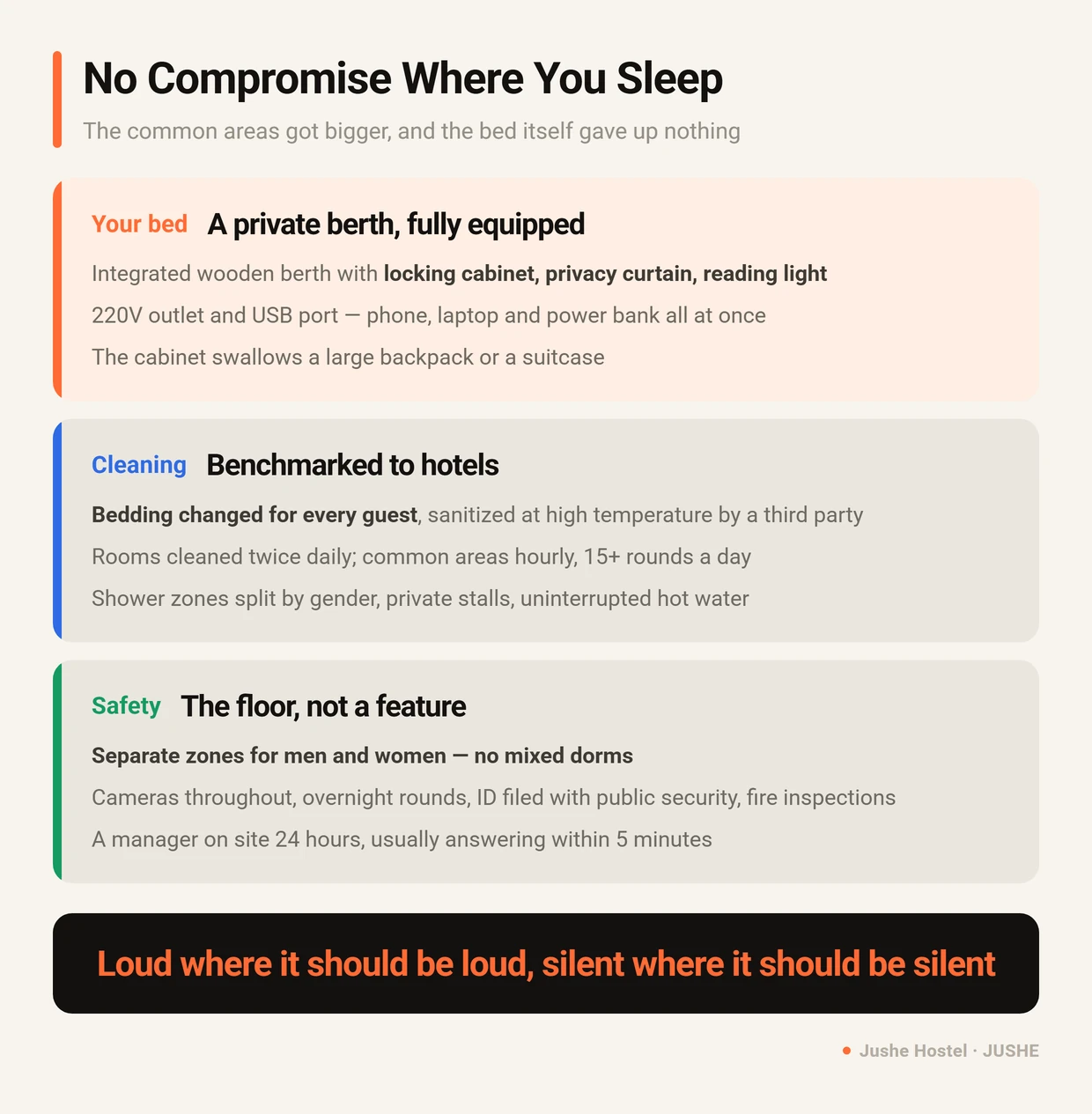
While the common areas got bigger, we gave up nothing on the part where you actually sleep.
Every bed is a purpose-built integrated wooden berth with a locking storage cabinet, privacy curtain, reading light, 220V outlet, and USB port as standard. Phone, laptop, and power bank charge together without a thought, and the cabinet swallows a large backpack or a suitcase.
Cleaning is benchmarked to hotels. Bedding is changed for every guest, with the full set of sheets, duvet cover, and pillowcase washed and sanitized at high temperature by a third-party specialist. Rooms are cleaned twice a day, morning and afternoon. Common areas and bathrooms get an inspection-and-clean round every hour, more than 15 rounds a day, and slippers are disinfected between guests. Shower areas are split into men's and women's zones with private stalls and uninterrupted hot water. Disposable toiletry kits, shampoo and body wash, and slippers are free, and there are gender-specific QR-code washers and dryers, a drying area, hair dryers, and a dedicated smoking area.
Safety is the floor: men and women stay in separate zones, and there are no mixed dorms. Cameras throughout, overnight security rounds, ID registration filed with public security, and regular fire-safety inspections. A manager is on site 24 hours and usually answers WeChat or a call within five minutes.
The dividend from scale goes to guests
Bigger common areas, fuller equipment — so does the price go up? Our answer: no, it goes down.
That is what large properties make possible. At 120–350 beds, central operations, smart energy management, and standardized purchasing finally have something to work on, and the cost per bed keeps thinning. Jushe does not keep that saving on the balance sheet. It goes straight to guests:
From 19 RMB a night · no deposit · one-night minimum · utilities included · check out any time · 24-hour self check-in — plus free cancellation before 6 p.m. on your first night. Less than a cup of milk tea a day buys an oversized common area, a free study room, hotel-grade cleaning, and a manager on site around the clock.
That is what 2.0 rests on: not a more expensive hostel, a better-value one. The full cost comparison is in long-term rental vs. short stay.
What we are actually building is a standard, not a chain
As of this writing, Jushe Hostel has opened four locations in prime Hefei districts since April 2025 (a fifth opened in August 2026 — see the update at the end), hosted more than 90,000 guest stays (as of January 1, 2026), and held a combined score of 4.6–4.7.
All four sit within walking distance of a metro station and run the same 2.0 standard:
· HFUT South Campus — Line 1 straight to both Hefei Railway Station and Hefei South Station; home base for exam prep and campus recruiting
· West Qilitang — Line 2 and Line 3, the Sanlian commercial hub next door, everyday convenience maxed out
· Sanxiaokou — Line 2 and Line 5 interchange, dead center of the city, one street from the pedestrian mall
· Hefei Railway Station — five minutes on foot into the station, instant check-in even at midnight
What we are really doing is not copy-pasting a fifth and tenth location. It is writing a repeatable 2.0 standard for the whole category: how to set bed counts, what share of floor area the common zone gets, how a study room should be equipped, how social flow should be planned, and where the hard lines on cleanliness and safety sit.
The name Jushe comes from ju, the tangerine — that orange warmth and energy — and she, a dwelling you feel settled in. Working from affordable, convenient, and dignified, we were never satisfied with running a cheap inn. We want to build a decent, secure, humane temporary home for every young person out chasing something. More of what we stand for is on the About Jushe page.
Hostel 1.0 sold a bed. Hostel 2.0 offers a way of living. Jushe is willing to be the one that moves first.
Update: In August 2026 our fifth Hefei location, Gaoxin West Bus Station, opened with 2026 finishes and the complete 2.0 common-area setup.
Hostel 2.0 is worth a night of your own. Browse every location and photo →